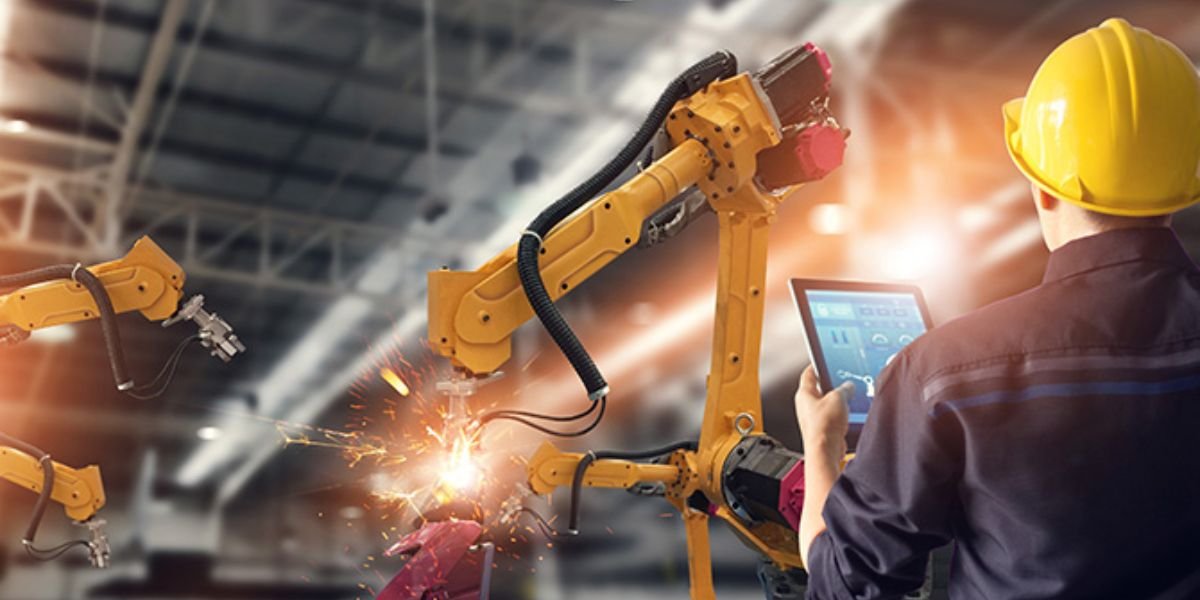
Walk onto the floor of a modern production facility, and the first thing that hits you is the rhythm. Servo-driven arms swing in tight, repeatable arcs. Conveyors hum at a constant pace. Parts move from station to station with almost no one touching them. You can tour plants on three continents, from a stamping shop outside Detroit to a contract electronics house near Shenzhen, and that same rhythmic precision shows up everywhere automation has taken hold. But automated manufacturing technology is not just robotic arms swinging across an assembly line. It is a layered system where physical equipment, sensing hardware, programmable logic, and software all work in concert.
True manufacturing automation depends on a network where machines, sensors, controllers, and data platforms communicate constantly. Raw material enters the plant, and from that point forward the system tracks it, shapes it, tests it, and moves it through every phase of production. Understanding how these layers talk to each other explains how today’s factories hit extraordinary output speeds while keeping scrap rates close to zero.
What Is Automated Manufacturing Technology?
Automated manufacturing technology is the integration of self-operating machinery, digital control systems, and information technology to carry out physical production tasks with minimal manual intervention. Traditional manufacturing leans on human operators to guide tools, set parameters, and handle workpieces by hand. An automated line hands the physical execution and much of the decision-making to programmed hardware instead.
It helps to separate basic mechanization from genuine automation, because the two get confused constantly. Mechanization gives a worker a powered tool to amplify their own effort, think of a manual drill press or an engine-driven lathe, but a person still stands there guiding every cut. Automation adds a closed control loop, where the system executes an operation, measures the result, and corrects its own behavior without someone watching each cycle.
None of this eliminates the need for skilled people on the floor, and anyone who tells you otherwise has not spent time in a real plant. What changes is the nature of the work. Engineers, technicians, and programmers shift from repetitive physical tasks toward system programming, preventive maintenance, quality oversight, and process planning. When something breaks mechanically, or a line needs reconfiguring, human judgment still gets the job done.
How Automated Manufacturing Works
Every automated production system runs on a continuous loop tying physical execution to digital logic. The sequence generally follows six steps, each built to keep process variables inside a tight tolerance band:
- Material Entry: Components are indexed and fed into the active cell through mechanized actuators or precision feeders.
- Controlled Operation: Primary machinery performs the designated transformation, whether that is cutting, welding, stamping, or dispensing a chemical compound.
- Real-Time Sensing: Embedded instrumentation measures positioning, force, and environmental conditions.
- Control Adjustment: Hardware reads the sensor data and instantly tweaks motor speed, pressure, or position.
- Automated Transfer: The part moves to the next workstation upon cycle completion.
- In-Line Quality Verification: System confirms the part meets its critical dimensions before it moves on.
That cycle depends on four distinct layers of hardware and software working in sync:
Machines and Production Equipment
This is the physical core of the factory floor, the heavy mechanical hardware that transforms raw material into finished parts. CNC mills, hydraulic stamping presses rated for hundreds of tons of force, automated arc welders, rotary liquid fillers, and surface-mount placement machines all fall into this category. What makes them valuable is not raw power alone, but their ability to repeat a high-precision action thousands of times a shift without structural degradation.
Sensors and Feedback
Sensors act as the nervous system of an automated plant. Inductive proximity switches, laser displacement sensors, thermocouple temperature probes, piezoresistive pressure transducers, and optical rotary encoders convert physical conditions into electronic signals continuously. That steady stream of data lets the control hardware confirm whether a physical event happened within tolerance, cycle after cycle.
PLCs and Control Systems
Programmable Logic Controllers, or PLCs, are the central processing units for floor operations. A PLC reads digital and analog signals from sensors across the line, runs its stored logic, and fires output commands to actuators, servo drives, pneumatic valves, and robot controllers. Brands like Rockwell Automation’s Allen-Bradley, Siemens’ SIMATIC, and Omron’s Sysmac dominate this space, executing logic scans in milliseconds, which prevents collisions and keeps process timing tight on high-speed lines.
Software and Production Data
Sitting above the machine controls are the enterprise systems that record and analyze plant performance. These platforms track output rates, unplanned downtime, cycle times, tooling wear, and first-pass yield. Turning raw sensor activity into readable metrics is what lets a plant manager spot a bottleneck before it costs a full shift of production.
Technologies Used in Automated Manufacturing
Modern facilities deploy a mix of technologies suited to each stage of fabrication, assembly, and inspection.
Industrial Robots
Articulated robotic arms with four to six axes of motion handle tasks that need spatial flexibility and reach. Heavy-duty units from Fanuc, ABB, KUKA, and Yaskawa perform spot welding on automotive frames, apply structural adhesive beads, assemble transmissions, pick parts off high-speed conveyors, and stack loaded pallets. Collaborative robots from Universal Robots have also become common on lighter-duty tasks where a robot works alongside a person rather than behind a fence. End-of-arm tooling ranges from pneumatic vacuum grippers to servo-driven mechanical claws, letting one robot be reprogrammed for a different part geometry within hours.
The pace of adoption keeps climbing. The International Federation of Robotics counted 542,000 new industrial robots installed worldwide in 2024, a record for the fourth straight year, pushing the global operational stock past 4.66 million units. China alone accounted for 295,000 of those installations, or 54% of the global total, while South Korea remains the density leader at 1,220 robots per 10,000 manufacturing employees. Robot safety standards have kept pace too. ISO 10218-1:2025 and ISO 10218-2:2025, published this year, replaced the 2011 versions to reflect how collaborative robots and AI-guided systems now share floor space with people.
CNC Machines
CNC machining converts a digital CAD model into precise cutting paths through subtractive manufacturing. Multi-axis mills, lathes, and electrical discharge machining equipment follow exact spatial vectors defined in the program. These machines are indispensable anywhere fractional-millimeter tolerances are non-negotiable, holding that same geometry across production runs numbering in the thousands.
Machine Vision
A machine vision package combines high-resolution industrial cameras, purpose-built LED lighting, and image-processing software. Systems from Cognex and Keyence, the two names that dominate this market, inspect part geometry, verify color, confirm label placement, read matrix barcodes, and catch microscopic surface defects at speeds no human inspector could match. Vision systems now feed AI-based defect classification models directly, flagging anomalies they were never explicitly trained to recognize, and they feed dynamic coordinates to robotic arms, letting a robot pick randomly oriented parts off a moving belt.
Automated Material Handling
Getting materials between workstations efficiently keeps a line from bottlenecking. Automated Guided Vehicles (AGVs) follow fixed floor tracks or magnetic tape to haul heavy loads, while Autonomous Mobile Robots (AMRs), the kind built by MiR and Locus Robotics, use laser-distance sensors and onboard mapping to navigate a dynamic floor safely around people. High-speed roller conveyors and Automated Storage and Retrieval Systems (ASRS) round out the category, handling high-density warehouse storage without a forklift operator.
Industrial Sensors
Solid-state sensors monitor micro-conditions across the machinery. Photoelectric sensors detect part presence, ultrasonic sensors track fluid levels in mixing vats, and tri-axial accelerometers pick up subtle vibration in a spindle running at high RPM. This constant monitoring catches mechanical play or thermal expansion before it turns into a scrapped part.
Manufacturing Control and Software Systems
Factory operations run on a layered control architecture. PLCs govern individual machine movements, while SCADA software monitors multiple equipment zones through a unified interface. Above that sit Manufacturing Execution Systems (MES), which direct plant-wide work orders, track material genealogy, monitor equipment effectiveness, and tie into ERP platforms.
Types of Manufacturing Automation
Choosing the right architecture comes down to production volume, product variety, and how much capital a company is willing to commit upfront.
Fixed Automation
Also called hard automation, this approach uses dedicated, purpose-built equipment for one product at very high volume. The operation sequence is fixed by the physical design of the machinery, transfer lines, and cams. Capital investment is steep and changeovers are difficult, sometimes requiring full retooling, but unit costs come in lower than any other method once volume justifies it.
Programmable Automation
Programmable automation handles batch runs of varied product configurations. The equipment changes its operational sequence through software commands and tooling changes, with runs typically ranging from dozens to thousands of units. Between batches, technicians reprogram PLCs, load new CNC tool paths, and adjust jigs by hand, meaning planned downtime during changeover.
Flexible Automation
Flexible automation builds on the programmable model but cuts out the lost time between product variants. A central controller reads an RFID tag as a part enters a cell and instructs the CNC machines and robots which variant is coming through. The equipment loads matching tool paths and adjusts its grippers automatically without stopping the line, allowing custom parts to be produced interchangeably within a single continuous run.
Integrated Automation
Integrated automation describes a fully computerized factory where processing cells, material handling, quality testing, and warehousing are all linked through a single digital framework. From order entry to shipment, human involvement is limited to high-level oversight and maintenance. This is the model most large automotive and semiconductor plants are pushing toward, even if few have reached it completely.
Operational Characteristics Across Automation Paradigms
- Fixed Automation: Production Volume: Extremely High | Product Variety: Very Low | System Flexibility: Rigid | Changeover Time: High / Difficult
- Programmable Automation: Production Volume: Medium | Product Variety: Medium | System Flexibility: Moderate | Changeover Time: Significant Downtime
- Flexible Automation: Production Volume: Low to Medium | Product Variety: Medium to High | System Flexibility: High | Changeover Time: Near Zero / Instantaneous
- Integrated Automation: Production Volume: Variable | Product Variety: Flexible | System Flexibility: Fully Adaptive | Changeover Time: Automated Continuous
Where Automated Manufacturing Is Used
Automated technology shows up differently across sectors, shaped by regulatory requirements, part sizes, and throughput.
Automated Vehicle Assembly
Automotive plants pack dense networks of six-axis robots into tight footprints. Robotic cells handle structural spot welding, apply anti-corrosion sealants, spray paint inside clean rooms, and mount heavy assemblies like windshields, battery trays, and engines. Global robot data backs up how dominant this sector remains, with automotive long standing as one of the largest single buyers of industrial robots worldwide, and in Mexico, automotive applications now account for 63% of new robot installations. Automated material carriers stay synced with the main overhead conveyor to deliver components with precise timing.
Precision Electronics Fabrication
Electronics manufacturing prioritizes spatial accuracy over lifting capacity. High-speed SMT pick-and-place machines from Panasonic, Fuji, and Yamaha use multi-nozzle vacuum heads to place micro-resistors and integrated circuits onto circuit boards, with the fastest platforms exceeding 100,000 components an hour. Machine vision guides these heads in real time, while automated optical inspection rigs check solder joints under high magnification immediately after.
High-Throughput Food and Beverage Packaging
Food processing prioritizes speed without sacrificing hygiene. Multi-head weighers divide bulk produce into exact retail portion weights, while high-speed indexing arms pack bottles into cases. Delta-style parallel robots, mounted overhead, sort and orient bakery items moving down wide conveyors, using food-grade grippers built to avoid damaging soft products during rapid transfers.
Pharmaceutical Processing and Containment
Pharmaceutical facilities run sterile cleanroom environments inside enclosed automated suites. Liquid filling lines wash, sterilize, fill, stopper, and seal glass vials inside isolators without an operator entering the critical zone. Vision systems inspect every vial for particulates or crimp seal defects, and line software keeps a complete electronic batch record to satisfy FDA audit trails.
Metalworking and Precision Component Fabrication
Metalworking facilities pair high-power cutting tools with automated load and unload systems. CNC turning centers work alongside robotic tending arms that pick raw alloy billets off pallets, load them into pneumatic chucks, and transfer finished parts to coordinate measuring machines. Coolant filtration, chip conveyors, and tool-wear compensation routines let these cells run unattended overnight.
What Manufacturers Gain From Automation
Automated systems change plant economics in measurable ways.
Output Consistency and Faster Cycle Times
Automated machinery runs at its designed speed continuously, without the pace variation that comes with human fatigue. Uninterrupted motion paths, optimized acceleration curves, and rapid pneumatic actuation shave seconds off cycle times, and across a multi-shift schedule, those seconds compound into a substantial jump in daily output.
Repeatable Quality and Error Elimination
People get tired, and attention naturally drifts over a long shift, introducing small process variances even from skilled operators. Automated systems apply exact mechanical force, hold spatial positions within micrometers, and maintain constant thermal parameters across millions of consecutive cycles. Cutting out that variability translates directly into lower scrap rates, less rework, and fewer warranty claims.
Workplace Safety Enhancement
Moving people away from hazardous machinery changes a plant’s safety profile fundamentally. Automated loaders and robotic arms now handle red-hot metal stampings, toxic chemical drums, heavy punch presses, and high-noise zones once staffed by hand. OSHA’s Technical Manual chapter on industrial robots, paired with the newly revised ISO 10218 series, shapes how plants design safety zones and lockout procedures around these cells.
Data Transparency and Unplanned Downtime Reduction
Connected automated lines generate a constant stream of performance data. Control software tracks cycle times, motor current draw, temperature spikes, and reject rates continuously. Maintenance teams that analyze these trends catch a failing bearing or a worn drive belt early, scheduling repairs before they turn into unplanned stoppages, which is where predictive maintenance has moved from buzzword to real budget item.
Automated Manufacturing, Industry 4.0, and Smart Factories
Traditional factory automation focused on making individual machines run faster in isolation. Industry 4.0 and smart factory architecture turn those isolated islands into one transparent data network, and 2026 is shaping up to be the year that shift goes mainstream. According to Deloitte’s 2026 manufacturing industry outlook, roughly 80% of surveyed executives plan to put at least a fifth of their improvement budgets toward smart manufacturing, covering automation hardware, data analytics, sensors, and cloud computing.
Industrial IoT and Real-Time Data Flow
The Industrial Internet of Things (IIoT) embeds network connectivity down to the individual sensor and actuator level. Using standardized protocols like OPC UA and MQTT, operational data bypasses local control silos and streams directly into centralized analytics databases, making metrics from every motor, valve, and heater visible across the enterprise almost instantly.
Edge Computing and Cloud Analytics
Smart factories split computational work between edge devices mounted on the shop floor and cloud servers. Edge hardware handles latency-critical decisions, like stopping a high-speed press the instant a sensor detects a misfeed, within milliseconds. Cloud infrastructure aggregates historical data across multiple global sites to spot broader inefficiencies and track energy patterns plant managers would never catch looking at one line at a time.
Digital Twins and Predictive Maintenance
A digital twin is a dynamic, high-fidelity virtual model of a physical production line, updated continuously with real-time IIoT sensor data. Plant engineers use it to test process changes, model line speed increases, or simulate a new product introduction without touching the physical line. This space has moved fast. At CES 2026, Siemens and NVIDIA unveiled Digital Twin Composer, part of an expanded partnership building what they call an industrial AI operating system, layering NVIDIA’s Omniverse platform under Siemens’ Xcelerator software. Predictive maintenance models built on this same data evaluate vibration signatures, thermal patterns, and power draw against historical baselines to forecast a component’s remaining useful life.
How AI Is Changing Automated Manufacturing
Artificial intelligence enhances traditional automation by giving control software the ability to adapt when it encounters variable physical inputs, something rigid, rule-based systems have always struggled with.
- Predictive Maintenance: Machine learning models evaluate subtle correlations across multiple sensor streams to flag mechanical degradation long before a part reaches structural failure.
- Visual Defect Detection: Deep learning models analyze real-time video to catch surface cracks, weld porosity, or finish anomalies that older rule-based vision systems would miss entirely.
- Adaptive Robotic Control: Vision-guided robots adjust pick angle and grip force on the fly with variable-geometry objects moving down a belt.
- Process Parameter Optimization: Optimization models continuously analyze sensor output, automatically tweaking feed rates, heating profiles, and pressure to maximize yield.
Deloitte’s 2026 outlook puts a number on how fast this is moving. The share of manufacturers planning to deploy physical AI, meaning AI embedded directly in machines and robots rather than back-office software, is expected to jump from 9% to 22% within two years. That tracks with what plant managers report on the floor, most of whom are no longer asking whether to pilot AI, only where to start.
It is worth being clear about what AI is not doing here. It is not replacing the underlying physical automation, and machine learning models do not build products by themselves. They function as an analytical layer above the PLCs, servo controllers, sensors, and robotic arms already in place. The physical work of cutting, moving, joining, and inspecting still depends on solid mechanical and electrical hardware.
A Real-World Automated Production Line
To see how these pieces work together, picture an automated automotive brake rotor line running with no direct manual component handling from start to finish.
At the intake bay, a heavy-duty pallet unloader picks up unmachined iron castings and sets them on a roller conveyor. An optical sensor reads a cast-in barcode as the casting moves inward, telling the central PLC which machining routine to recall for that part variant.
The conveyor carries the casting into a CNC machining cell, where a gantry robot lowers its dual-jaw pneumatic gripper, lifts the casting off the conveyor, opens the machine’s safety door, and clamps the part into the hydraulic chuck. Inside the enclosed cabinet, carbide tooling turns the faces and drills mounting holes while pressure transducers monitor cutting resistance. If a sensor picks up an abnormal force spike, suggesting a chipped insert, the CNC software pauses instantly and flags the line supervisor.
Once machining finishes, the gantry robot moves the hot rotor to a cooling station, where air knives bring its temperature down before it enters an inline vision inspection module. A high-resolution camera array captures magnified images confirming bore diameter, hole position, and surface flatness all sit within tolerance.
After inspection, the rotor moves to a dynamic balancing rig. A high-speed spindle spins it while piezoelectric sensors calculate any weight imbalance, and an integrated micro-milling head shaves excess material off the outer vane to bring the part into precise balance.
Finally, a six-axis packaging robot picks the finished rotor, applies a protective oil mist to prevent corrosion, and boxes it. A strapping machine wraps the box, prints a shipping label, and routes it to an ASRS warehouse rack. Throughout, the local PLC updates the plant’s MES software, tracking genealogy, cycle timing, and tool wear without a human hand touching the part.
Choosing the Right Automation Approach
Deploying manufacturing automation means matching system capability to operational and financial reality. The right system is not the most advanced one on the market, but the one that maximizes efficiency for a particular product’s profile.
Production Volume versus Product Variety
Facilities producing millions of identical parts each year get the most out of fixed automation, where extreme throughput offsets the high initial cost. Job shops handling low volumes of customized components need programmable or flexible automation instead, things like multi-axis CNCs and adaptable robotic cells that reconfigure quickly without a lengthy shutdown.
Process Stability and Component Standardization
Automation needs consistent physical inputs to run reliably. If raw material dimensions vary too much, or an upstream process leaves inconsistent burrs, automated feed mechanisms will jam. Process steps need to be stabilized before a plant layers complex handling equipment on top.
Capital Investment and Technical Support Capability
Advanced machinery demands real upfront capital for hardware, software licensing, system integration, and safety infrastructure. Beyond equipment cost, management must ensure maintenance staff have the skills to troubleshoot PLC networks, calibrate vision cameras, and service robotic drives. Too many automation projects stall not because the technology failed, but because the plant never built the expertise to run it.
Final Thoughts
Modern automated manufacturing is no longer a collection of isolated machines running rigid routines. Real competitive advantage now belongs to facilities that integrate physical machinery, precision sensors, logic controllers, and enterprise data networks into one coherent production architecture. When these technologies work in true harmony alongside skilled supervisory personnel, factories gain the agility, throughput, and quality control needed to compete in a global market that is not slowing down.