Modern manufacturing floors are quietly abandoning the old model of standalone machinery running its own schedule in its own corner of the plant. In its place, operators are building synchronized production ecosystems where artificial intelligence sits inside live operations rather than watching from a dashboard, where connected sensors have replaced isolated control panels, and where flexible robotics handle complex physical tasks side by side with human crews. Plants across North America and Europe are rebuilding around four priorities: data visibility, supply resilience, lower energy spend, and real defenses against network intrusions that used to be someone else’s problem.
None of this happened overnight, and none of it is finished. Fortune Business Insights tracks the smart factory market climbing past $185 billion in 2026, on its way toward roughly $384 billion by 2034 at a compound growth rate near 9.6%. That kind of money moves because plant managers are under real pressure to cut scrap, protect uptime, and answer for every dollar of energy and labor spent on the floor. The sections below walk through where that pressure is actually landing in 2026.
1. AI Is Moving Into Day-to-Day Factory Decisions
Operational planning on the floor has stopped relying on yesterday’s spreadsheet and a supervisor’s gut feel. Artificial intelligence now reads live feeds coming off the production line itself, comparing current output against open order volume in real time and nudging machine speeds or raw material transfers accordingly. Vision-based quality systems built on machine learning catch sub-millimeter defects on conveyor lines moving too fast for a human eye to track, flagging process drift before it ruins an entire batch.
The bigger shift arriving in 2026 is agentic AI, and this is not a marketing label attached to the same old dashboards. Gartner reported that 40% of enterprise applications will carry task-specific AI agents by the end of 2026, up from under 5% in 2025, and manufacturing software vendors have been racing to hit that curve. What makes agentic systems different from a chatbot bolted onto an MES screen is that they act on multiple independent variables across a production unit at once. A properly configured agent network can rebalance a line, order a secondary tool, or adjust a furnace setpoint the moment it detects a bottleneck, without an engineer approving each individual step.
That distinction matters because it changes what automation has meant for decades. Traditional factory automation follows rigid, hard-coded logic: a limit switch trips and the line stops, full stop. The generation of AI that arrived over the last several years improved on this by offering data-backed suggestions to a human engineer, such as flagging an optimal maintenance window based on thermal creep in a bearing. Agentic systems go a step further and take the action inside pre-approved safety parameters, rerouting material flow or recalibrating a process variable, then notifying the shift supervisor after the fact. Plants adopting this model are not removing the human from the loop. They are moving that person from executing routine adjustments to reviewing the exceptions the system could not resolve alone.
2. Smart Factories Are Becoming Connected Production Systems
Bolting a wireless sensor onto a twenty-year-old stamping press does not make a plant smart, and most experienced automation engineers will say so bluntly. Real connectivity happens only when that equipment feeds a unified platform that gives operators one clear, live view of performance across every stage of production, not a folder of disconnected readouts. Modern industrial IoT deployments link field sensors, PLCs, and enterprise systems using open protocols, principally OPC UA for structured data modeling and MQTT for lightweight, low-bandwidth messaging between devices and the cloud. The OPC Foundation has spent the past several years pushing major automation vendors toward a shared companion specification precisely so a sensor from one manufacturer and a controller from another can speak the same language without a custom integration project.
One practical shift in plant connectivity right now is the direct use of edge gateways with built-in cellular modems, which lets a maintenance team pull vibration or structural data straight from a piece of specialized equipment without waiting months for internal IT to approve a new network path. That change has cut a multi-month rollout down to a matter of days on plenty of retrofit projects.
The industrial IoT segment alone is expected to capture more than 42% share of the roughly $185 billion smart factory market in 2026, with discrete manufacturing accounting for close to 59% of total spend. Asia Pacific still leads on raw volume, holding around a third of global revenue, largely on the strength of electronics and automotive production in China and Japan. But the real value of connectivity was never about the volume of gigabytes generated. Data becomes valuable only when it changes a decision quickly enough to matter. Wiring an injection molding machine into a manufacturing execution system so cycle time adjusts automatically when resin moisture shifts is a small, unglamorous example, but it protects thin margins every single shift.
3. Digital Twins Are Becoming More Useful on the Production Floor
The idea of a digital twin used to mean an abstract 3D rendering of an entire facility that looked impressive in a boardroom and did little on the actual floor. That has changed. Practical digital twins now attach to specific machines, individual production cells, and single processing units, giving floor supervisors a live virtual model that mirrors real physical conditions, tracking stress points, thermal loads, and cycle times as they happen rather than after a shift report is filed.
Adoption has moved faster than most outside the industry realize. Industry surveys compiled through 2025 and 2026 put digital twin adoption among manufacturers at roughly 69%, with about 40% of that group still in a pilot phase and closer to 20% running twins across full operations. The reported payoffs explain why manufacturers keep funding these projects even in a tight capital environment: organizations running mature digital twin programs report up to a 65% decrease in unplanned downtime, alongside development-cycle reductions approaching 50%.
The simulation side is where time savings show up most clearly. When a plant needs to introduce a new automotive chassis design, engineers can run the change through the twin first, testing robot arm pathways, spotting line congestion, and calculating tool wear before a single physical fixture is built, shaving days off a retooling schedule and avoiding costly tooling mistakes. Maintenance teams benefit in a quieter way too. Tracking heat buildup and shaft vibration inside the virtual model gives technicians visibility into internal wear weeks before it would otherwise surface, enough lead time to order a replacement part rather than scramble for one after a failure.
4. Robotics Is Moving Beyond Fixed Automation
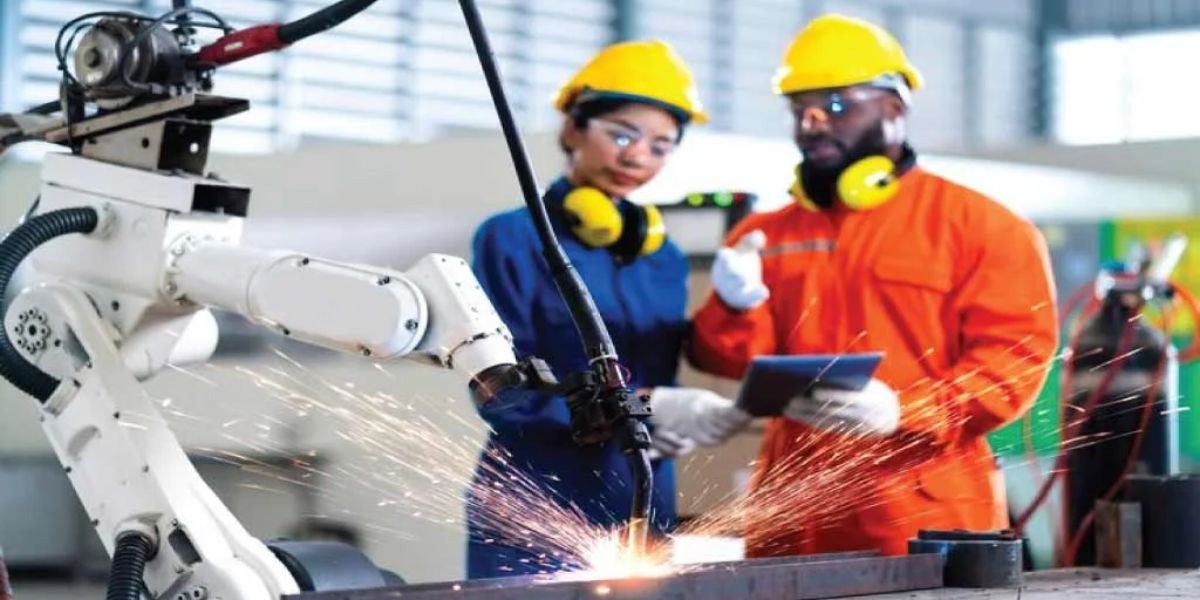
High-speed robot arms fenced off behind safety cages are still common on high-volume lines, and they are not going anywhere in operations built around a single product running for years. But the growth of short-run manufacturing and mixed-model lines has pushed demand toward robotics that can be repositioned and reprogrammed in hours instead of weeks.
Collaborative robots, or cobots, work directly beside plant personnel without a safety cage, relying on force-torque sensors and vision monitoring to stop the instant they contact a person. Grand View Research puts the global cobot market at roughly $2.95 billion in 2025, climbing toward $4.03 billion in 2026 and continuing at a projected 23.1% compound annual growth rate through 2033, when the market is expected to exceed $17 billion. Automotive assembly, welding, and painting remain the dominant use case, though electronics manufacturers are adopting cobots quickly for precision component assembly. Lightweight units rated up to 5 kilograms still hold the largest installed share, around 44%, even as heavier-payload models gain ground in industries needing more robust handling. These robots take over repetitive work such as palletizing, machine tending, and fastener driving, freeing skilled workers to focus on assembly problems that actually require judgment.
Autonomous mobile robots, or AMRs, are doing something similar for material movement. Guided by LiDAR and AI-based vision rather than a fixed magnetic strip, AMRs are replacing conveyor belts and manual forklifts on plenty of floors, adjusting their own routes around people and obstacles to keep parts and finished goods flowing through busy aisles. MarketsandMarkets projects the AMR market will reach roughly $7.07 billion by 2032, growth driven as much by warehouse and distribution work as by manufacturing itself.
5. Predictive Maintenance Is Becoming More Data-Driven
Fixed calendar maintenance and reactive repair are both expensive habits. Waiting for a motor to fail damages the equipment around it and stalls the whole line, while replacing a part on a rigid schedule regardless of its actual condition wastes good components and labor hours. The cost of getting this wrong is larger than most plants admit. Industry maintenance research puts unplanned downtime at an average of $2.8 billion a year for a typical Fortune 500 company, roughly 11% of revenue, and separate analysis of large manufacturing plants found average annual losses near $253 million from unplanned downtime alone, with the per-hour cost of a stoppage roughly doubling between 2019 and 2024.
Modern predictive maintenance replaces the guesswork with sensor data tracked continuously against a machine’s own performance baseline:
- Vibration analysis catches early bearing wear and shaft misalignment before it becomes audible.
- Acoustic emission monitoring picks up high-frequency friction inside a sealed gearbox no external inspection would find.
- Thermal imaging spots a loose electrical connection before it trips a breaker.
- Oil condition analysis tracks metallic debris and fluid degradation inside hydraulic systems, often the earliest warning sign on heavy equipment.
When a spindle shows a minor vibration anomaly, the machine learning model behind these sensors flags it and estimates remaining useful life, giving the maintenance team a real window to schedule the repair during a planned shift change instead of an emergency stop.
Oddly, adoption has softened slightly rather than accelerated, with reported predictive maintenance adoption slipping from about 30% in 2024 to 27% in 2025, likely a reflection of tighter capital budgets rather than any loss of confidence in the technology. The upside case remains large. Full adoption of condition monitoring across Fortune 500 manufacturers is estimated to be worth 2.1 million hours of avoided downtime and roughly $233 billion in maintenance savings annually, and plants that implement predictive maintenance typically see maintenance costs fall by up to 25% while uptime climbs 10 to 20%.
6. Computer Vision Is Changing How Manufacturers Inspect Products
Manual quality inspection is slow, and it is vulnerable to the same fatigue any repetitive human task produces over an eight-hour shift, especially on a fast-moving line. Automated computer vision paired with deep learning models now inspects products at full line speed, catching surface scratches, weld defects, and dimensional errors that would slip past a tired inspector, and doing it consistently on the ten-thousandth part just as well as the first.
This has become a genuinely large market. Recent industry analysis values global AI vision inspection at roughly $32.66 billion in 2025, projected to grow at a 22.88% compound annual rate toward more than $256 billion by 2035, nearly an eightfold increase over the decade. Defect detection and quality control account for about 41% of current applications, the largest single use case, followed by assembly verification and then packaging or label verification for downstream traceability. Deep learning techniques represent roughly a third of the underlying technology mix, and close to 58% of new installations run on edge hardware directly on the line rather than routing images to a distant cloud server, which matters when a defect decision has to happen in milliseconds.
Electronics and semiconductor manufacturing lead adoption by industry vertical, given how unforgiving those tolerances are, with automotive close behind. Pharmaceutical and healthcare manufacturing is reportedly the fastest-growing vertical for vision inspection, driven by regulatory pressure around batch traceability and label accuracy. Still, no vision system replaces experienced human inspectors entirely. When a line encounters an unusual material variation or an unfamiliar surface finish, a trained human eye reviews flagged parts, retrains the model’s parameters, and prevents good product from being rejected over a false positive.
7. Additive Manufacturing Is Finding More Production Applications
Three-dimensional printing moved past its rapid-prototyping origins years ago and is now a genuine tool for end-use industrial production, not just a way to check a design before committing to real tooling. Advances in direct metal laser sintering and industrial-grade polymers let plants print complex, durable components that traditional cutting or casting cannot reproduce economically, particularly internal lattice structures or organic geometries designed for weight reduction.
The 31st edition of the Wohlers Report, published in February 2026 through ASTM International’s platform, values the global additive manufacturing market at $24.2 billion for 2025, up 10.9% year over year. That growth rate is notably slower than the 20%-plus annual expansion the industry saw before the pandemic, and Wohlers analyst Dr. Mahdi Jamshidi has noted that additive manufacturing is no longer advancing on a single uniform growth curve, with tighter capital now shaping where the money goes. Printing services made up the largest slice of revenue at 48%, ahead of system sales and servicing at 26% and materials at 20%. Growth was strongest in Asia-Pacific at nearly 20%, compared with 12.6% in the Americas and 9% across Europe, the Middle East, and Africa.
Inside a plant, the practical use cases have narrowed to where additive genuinely wins: lightweight structural brackets for aerospace and automotive programs, custom assembly jigs and robotic end-effectors built on demand, rare replacement parts printed to avoid a long outage, and low-volume components where tooling costs would otherwise make the run uneconomical. High-speed stamping and conventional machining remain far cheaper for high-volume parts. Machining a basic steel bracket takes seconds, and printing the same part can take hours plus post-processing, so most plants use additive for complex, low-volume work and conventional equipment for everything produced at scale.
8. Manufacturers Are Paying More Attention to Their Data Infrastructure
An advanced analytics platform or AI model is only as good as the data feeding it, and a lot of plant floors still cannot promise clean, timely data. Legacy machinery without any digital output, proprietary control systems never designed to share information, and equipment from a dozen vendors speaking a dozen formats all conspire to trap useful telemetry right where it was generated. The result is data that arrives late, inconsistent, or not at all, often compounded by poor sensor calibration or dropped signals.
The fix gaining traction in 2026 is edge computing deployed directly on the floor, cleaning and standardizing data before it ever leaves the building. These edge devices translate legacy protocols into open standards like MQTT before forwarding structured metrics to a central platform, and the performance difference is not subtle. Vendors report inference latency dropping to the 10 to 50 millisecond range on edge hardware, compared with 200 to 500 milliseconds when everything routes through the cloud, alongside data transfer cost reductions approaching 40%. Manufacturers who have made this investment report meaningful downstream gains too, including scrap-rate reductions near 35% tied to faster, locally processed vision inspection. Building that clean data layer is not the exciting part of a modernization project, but every AI initiative built on unreliable inputs eventually produces unreliable recommendations, so plant managers who skip this step tend to pay for it twice.
9. OT Cybersecurity Is Becoming Part of Factory Modernization
Connecting equipment to corporate networks and cloud platforms exposes plant floors to risk they were shielded from for decades by physical isolation. Operational technology, meaning industrial controllers, robotic cells, and safety interlocks, used to sit on its own network with no path in from outside. Every sensor added and every remote maintenance connection opened since has chipped away at that isolation, and attackers have noticed.
The ninth annual Dragos OT Cybersecurity Year in Review, released February 17, 2026, is blunt about where things stand. In 2025, 119 distinct ransomware groups hit 3,300 industrial organizations, a 49% jump from the 80 groups tracked in 2024, and manufacturing accounted for more than two-thirds of all ransomware victims across every sector Dragos tracks. Three new threat groups, tracked as Azurite, Pyroxene, and Sylvanite, emerged over the year. Two established groups, Kamacite and Electrum, ran systematic reconnaissance against United States targets between March and July 2025, and Electrum went on to hit Polish energy infrastructure in December 2025, attacking distributed energy resources at scale. A separate group, Voltzite, reportedly reached the point of directly manipulating engineering workstations, a level of access security teams consider especially dangerous.
The defensive picture in the same report is not encouraging:
- Roughly 81% of assessments identified poor segmentation between IT and OT networks, meaning an intrusion on the office side can reach production systems with little resistance.
- Compromised VPN or jump-host credentials were involved in 73% of incident response cases Dragos has handled historically.
- Only 46% of assessed environments had adequate OT network monitoring in place.
- Roughly 30% of incident response cases began as what looked like an ordinary operational problem before investigators traced it to a cyber incident.
Practical defenses that keep coming up include network micro-segmentation, zero-trust access rules for any technician or vendor connecting remotely, continuous monitoring for unauthorized protocol changes, and patch workflows built for equipment that cannot go offline for a routine update. Cybersecurity bolted on years after a network upgrade is no longer defensible for any plant serious about protecting itself from ransomware, data theft, or physical tampering.
10. Energy Management Is Becoming Part of Production Technology
Energy used to be a line item a plant controller reviewed once a quarter. It is now tracked at the level of an individual machine, and the pricing environment explains why. The U.S. Energy Information Administration outlook shows average wholesale power prices reaching roughly $47 per megawatt-hour in 2025, about 23% higher than 2024, with 2026 projected to climb further to around $51 per megawatt-hour, another 8.5% increase. Some regions are seeing sharper moves still. ERCOT, covering most of Texas, is projected to see prices rise as much as 45% in 2026, driven by summer demand spikes colliding with tight supply. National electricity demand is rising too, with the EIA projecting sales growth around 2.6% in 2026, and Texas, Oklahoma, Louisiana, and Arkansas alone expected to account for roughly 66% of the nation’s total electricity sales growth that year, much of it tied to data center and industrial expansion competing for the same grid capacity.
Against that backdrop, tracking energy at the machine level stops being a sustainability talking point and becomes a straightforward cost control measure. Combining power monitoring with production scheduling lets a plant stagger the startup of heavy equipment like furnaces or large compressors to avoid the peak-demand charges utilities use to penalize simultaneous high draw. Automating low-power standby modes during shift changes and off-hours produces savings that show up directly on the utility bill, and with prices moving the way the EIA is forecasting for 2026, that margin protection matters more this year than it has in a long while.
What These Trends Mean for the Modern Factory
None of these ten shifts produces its full value in isolation. The real payoff shows up when connected systems work together inside one facility rather than as separate vendor projects competing for budget. IoT sensors pull raw performance data off the machinery, edge processors clean and standardize it, and AI models analyze the result to recommend adjustments that automated controllers and robotic cells then carry out on the floor within seconds, not the next shift meeting.
As plants build that level of integration, OT cybersecurity and real-time energy monitoring become the structural supports holding the rest of it up. Strong network segmentation protects every other investment on this list from being wiped out by a single ransomware incident, and dynamic energy tracking keeps operating costs predictable even as wholesale prices climb faster than they have in years. Put together, this interconnected approach turns a traditional plant into an adaptable, resilient production network that can absorb a supply shock or a demand spike without falling over.
Where Manufacturers Should Focus Their Technology Investment
Every one of these investments should start from a specific, named operational problem, never from a general desire to look modern. Choosing an upgrade because it solves a bottleneck a plant manager can point to on a whiteboard is what makes a project deliver measurable, long-term return rather than becoming a pilot that quietly dies after its first budget review.
That discipline matters more than it sounds like it should. Plants that chase whichever technology is generating the most conference buzz tend to end up with a flashy pilot that never scales past one line. Plants that start with their worst-documented bottleneck, whether that is unplanned downtime, scrap rate, cybersecurity exposure, or an energy bill trending the wrong way, tend to build something that survives next year’s budget cycle. Staying close to the recent trends in manufacturing technology covered here gives operations teams a realistic map of what is actually working across the industry in 2026, a far better starting point than guessing.