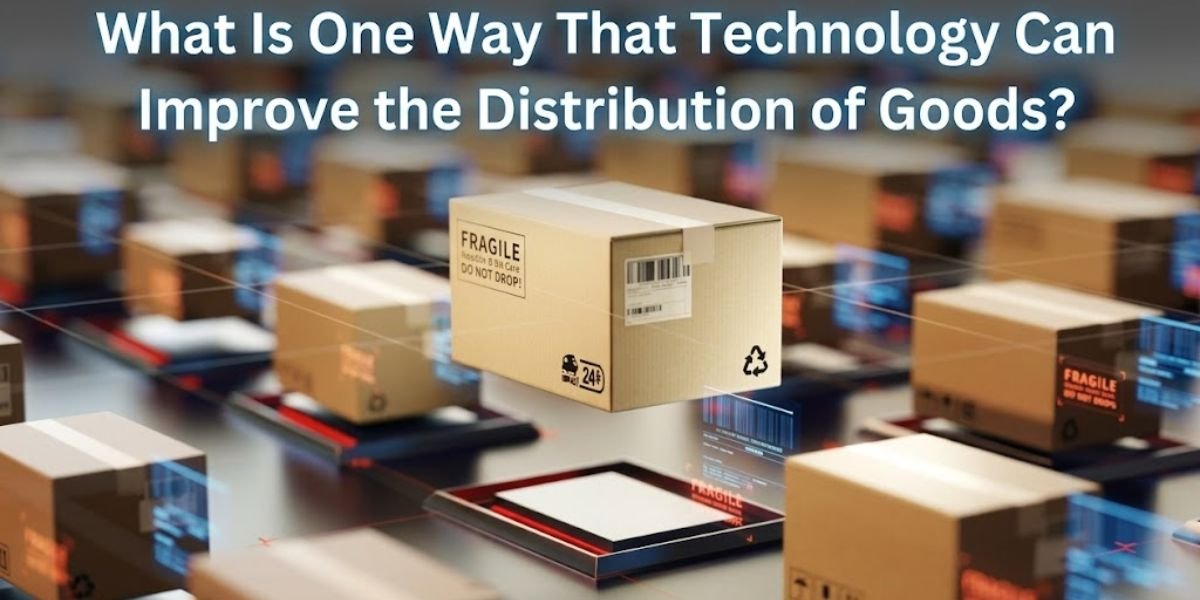
The most immediate and transformative way technology improves the distribution of goods is through the integration of real-time supply chain visibility powered by artificial intelligence, cloud logistics, and the Internet of Things.
In the modern economy, knowing where a product is located at any given second has shifted from a luxury to a baseline operational requirement.
This digital shift enables businesses to identify exactly where products are, how quickly they are moving through transit, and where potential bottlenecks are forming before they result in empty shelves.
Instead of a linear, reactive chain, technology has created a predictive ecosystem. By leveraging high velocity data, companies can now forecast regional demand with extreme precision, automate the mechanical movement of goods in warehouses, and slash delivery windows from weeks to hours.
In the United States, this transition has become a primary survival mechanism for retail, healthcare, and food distribution. Organizations that can move products with greater speed and accuracy inherently reduce their overhead while capturing a higher market share.
The backbone of the modern supply chain is no longer just physical trucks or massive warehouses. It is the continuous flow of data that dictates every movement within the network.
Why Distribution Became a Technology Problem
For the better part of the last century, distribution was a manual and often invisible process. Inventory was tracked on paper ledgers or basic spreadsheets, shipping updates were delayed by days, and businesses frequently discovered shortages only after a customer walked away disappointed. This traditional model was built for a slower world with less consumer choice.
The landscape changed permanently with the explosion of e-commerce. Consumers in the U.S. now demand same-day shipping, live map tracking for their packages, and absolute inventory accuracy.
This pressure forced a rapid evolution. Logistics providers had to abandon old methods and adopt automated systems just to keep up with the volume of orders generated every minute.
Today, distribution is inseparable from cloud computing and machine learning. The fastest-growing companies are those that have successfully removed friction between the point of manufacture and the final doorstep.
By treating distribution as a software challenge rather than just a physical one, these firms can scale operations without a proportional increase in human error or manual labor.
Real-Time Tracking Changed Everything
The introduction of GPS and Internet of Things (IoT) sensors has essentially made the supply chain transparent. In the past, once a truck left a loading dock, it entered a black box until it reached its destination. Now, every pallet and vehicle can be a connected node in a global network.
Logistics managers now utilize a suite of sophisticated tools to maintain control:
- Smart sensors that monitor cargo temperature and humidity.
- RFID tags that allow for touchless inventory counts in seconds.
- Telematics devices that track driver behavior and fuel efficiency.
- High-resolution satellite tracking to bypass regional traffic or weather disasters.
This level of visibility is particularly vital for the cold chain in the pharmaceutical and food industries. If a shipment of vaccines or fresh produce deviates from its required temperature, sensors trigger immediate alerts to the driver and the central office.
This prevents the distribution of spoiled goods and saves millions of dollars in potential waste. In the U.S., these systems were the unsung heroes of large-scale medical distribution efforts over the last few years.
Artificial Intelligence Is Reshaping Warehouses
The modern warehouse is no longer a dark storage space for boxes. It is a high-tech fulfillment engine where AI and robotics handle the heavy lifting. Advanced distribution centers now utilize autonomous mobile robots to navigate aisles, bringing products directly to human packers rather than making workers walk miles every shift.
Beyond physical movement, machine learning algorithms are used for predictive slotting. The system analyzes order history to identify which items are trending. It then instructs the warehouse staff to move those items to the most accessible locations near the shipping bays.
By optimizing the physical layout based on digital data, facilities achieve several key benefits:
- Significant reduction in order fulfillment time.
- Drastic decrease in human picking errors.
- Better utilization of vertical and horizontal square footage.
- Enhanced worker safety by automating high-risk or repetitive tasks.
The surge in logistics robotics companies across North America highlights that automation is now the standard for any facility handling high-volume retail or industrial components. Efficiency is no longer gained through working harder, but through smarter algorithmic orchestration.
Cloud Computing Quietly Powers Modern Distribution
While robots and drones get the most attention, cloud infrastructure is the silent engine that allows all these parts to communicate. Cloud logistics platforms serve as a single source of truth, connecting suppliers in one country with warehouses in another and final-mile delivery drivers in a local city.
Before the cloud, data lived in silos. The warehouse system did not talk to the shipping system, which did not talk to the customer service portal. This fragmentation caused massive delays. Cloud adoption has effectively unified these layers into a centralized operational view.
Modern cloud systems provide critical resilience for American businesses:
- Real-time inventory syncing across multiple physical locations.
- Automated reordering triggers when stock hits a specific threshold.
- The ability to reroute shipments globally in response to port closures or strikes.
- Seamless integration with third-party delivery partners to find the lowest shipping rates.
Following the global disruptions of the early 2020s, U.S. firms realized that visibility was their most valuable asset. The cloud provides that visibility at a scale that local servers simply cannot match, making it the core infrastructure of modern trade.
The Rise of Smart Distribution Centers
A major shift in the American landscape is the transition from massive and isolated warehouses to a network of smart distribution centers and micro-fulfillment hubs. Traditionally, companies relied on a few giant facilities located in rural areas where land was cheap. However, the demand for instant delivery has forced inventory closer to the customer.
Smart warehouses use AI to analyze local buying patterns. If data suggests a specific neighborhood has a high demand for a certain electronic device, the system automatically positions that stock in a small automated hub just a few miles away. This strategy effectively:
- Eliminates the need for long-haul trucking for every order.
- Reduces the dead time between a customer clicking buy and the item leaving the facility.
- Allows retailers to use their physical storefronts as mini-distribution points.
By placing these automated hubs in urban centers, businesses can achieve sub-two-hour delivery windows that were previously impossible. This localized approach is a direct result of predictive analytics telling companies what people want before they even order it.
Last-Mile Delivery Is Becoming a Technology Race
The final leg of a product journey, known as the last-mile, is notoriously the most expensive and inefficient part of the entire distribution process. It involves navigating complex city traffic, finding parking, and ensuring the customer is home. Technology is attacking these inefficiencies from multiple angles.
Route optimization software has evolved far beyond basic GPS. Modern algorithms now factor in:
- Real-time traffic density and historical patterns.
- The number of left-hand turns is reduced to save fuel and time.
- Optimal loading sequences so the driver does not have to dig through the van.
- Weather-related delays that might impact battery life for electric delivery vans.
Beyond software, the physical delivery methods are changing. Many U.S. companies are actively piloting autonomous sidewalk robots and drone delivery systems. While these are still being refined, they represent a future where the cost of moving a small package across a city drops to near zero.
Even without full autonomy, the use of AI-driven dispatch ensures that every vehicle in a fleet is following the most logical and fuel-efficient path possible.
Data Is Now More Valuable Than Warehouse Space
In the past, the strongest logistics companies were the ones with the most trucks or the biggest buildings. Today, that hierarchy has flipped. Predictive data has become the most valuable asset in the distribution chain.
Advanced analytics allow businesses to move away from guessing what they need. Instead of reacting to a shortage, they use demand forecasting to anticipate it.
For example, if a weather event is predicted for the Northeast, AI systems can automatically trigger the movement of emergency supplies and cold-weather gear to those regions days in advance.
This data-driven approach prevents two of the biggest profit killers in distribution:
- Overstocking: Having too much money tied up in inventory that is not moving.
- Understocking: Losing a sale because an item is out of stock.
When a company understands its data, it can operate with a lean inventory. This means they carry exactly what is needed, reducing the need for massive and expensive warehouse footprints.
What Smaller Businesses Often Get Wrong
There is a common misconception that high-level distribution technology is only for trillion-dollar corporations. This line of thinking often prevents smaller businesses from scaling. Today, the SaaS model has democratized access to enterprise-grade tools.
Small to medium-sized businesses can now integrate:
- Cloud-based inventory management that syncs with their online store.
- Automated shipping platforms that compare rates across dozens of carriers.
- AI tools that flag when a specific product is likely to sell out.
The biggest error small firms make is sticking to manual entry for too long. Spreadsheets cannot account for real-time shipping delays or sudden viral spikes in demand. Moving to even a basic automated system can free up dozens of hours a week. This allows the business owner to focus on growth rather than tracking down a missing box.
Sustainability Is Becoming Part of Distribution Technology
Environmental impact is no longer a secondary concern. It is now a core part of distribution efficiency. In the U.S., heavy transport is a major source of emissions, and technology is providing the tools to reduce that footprint while simultaneously lowering costs.
Green logistics is powered by:
- Electric vehicle (EV) fleet management that optimizes charging schedules to avoid peak utility rates.
- Packaging optimization AI that calculates the smallest possible box for any given order, reducing waste.
- Load pooling, where AI connects different companies to share space on a single truck, ensuring no vehicle drives half-empty.
Efficient routing does not just save time. It saves millions of gallons of fuel annually. For modern businesses, being green is often synonymous with being mathematically efficient.
What the Next Five Years Will Likely Look Like
We are moving toward an era of autonomous logistics and hyper-automation. The next phase of distribution will likely involve dark warehouses. These are facilities that are entirely automated and require no human lighting because robots are doing all the picking and packing.
Key trends to watch include:
- Digital Twins: Creating a virtual replica of a supply chain to test different scenarios before they happen.
- Edge Computing: Processing data locally on delivery vehicles to make split-second routing decisions without waiting for a cloud response.
- Blockchain for Transparency: Using secure ledgers to track the ethical sourcing and movement of high-value goods.
While these technologies offer incredible speed, they also require a heightened focus on cybersecurity. As the distribution of physical goods becomes more reliant on digital code, protecting those systems from interference will be as important as locking the warehouse doors.
Final Thoughts
Technology has turned the distribution of goods from a slow and manual labor task into a high-speed digital science. The most significant improvement is not any single machine, but the ability to use real-time data to make better decisions.
By embracing AI, cloud connectivity, and advanced tracking, businesses can move products faster, cheaper, and with far less waste.
In a competitive market, the organizations that treat their supply chain as a technological asset rather than a cost center are the ones that will define the future of global trade.
Frequently Asked Questions
What is one major way technology improves the distribution of goods?
The primary improvement is real-time visibility and automation. This allows companies to track every item and automate its movement, reducing delays and human error.
How does AI help with product distribution?
AI predicts exactly how much stock is needed and where it should be stored. It also calculates the fastest delivery routes to save time and fuel.
Why is last-mile delivery so important?
It is the most expensive part of the journey. Improving this step with technology directly impacts a company’s profitability and customer satisfaction.
Can small businesses afford this technology?
Yes. Through cloud-based software, small businesses can access the same tracking and inventory tools used by large corporations without a massive upfront investment.
What is a smart warehouse?
A smart warehouse uses robots and AI to manage inventory. It can organize itself, predict which items will sell, and prepare orders for shipping with minimal human intervention.