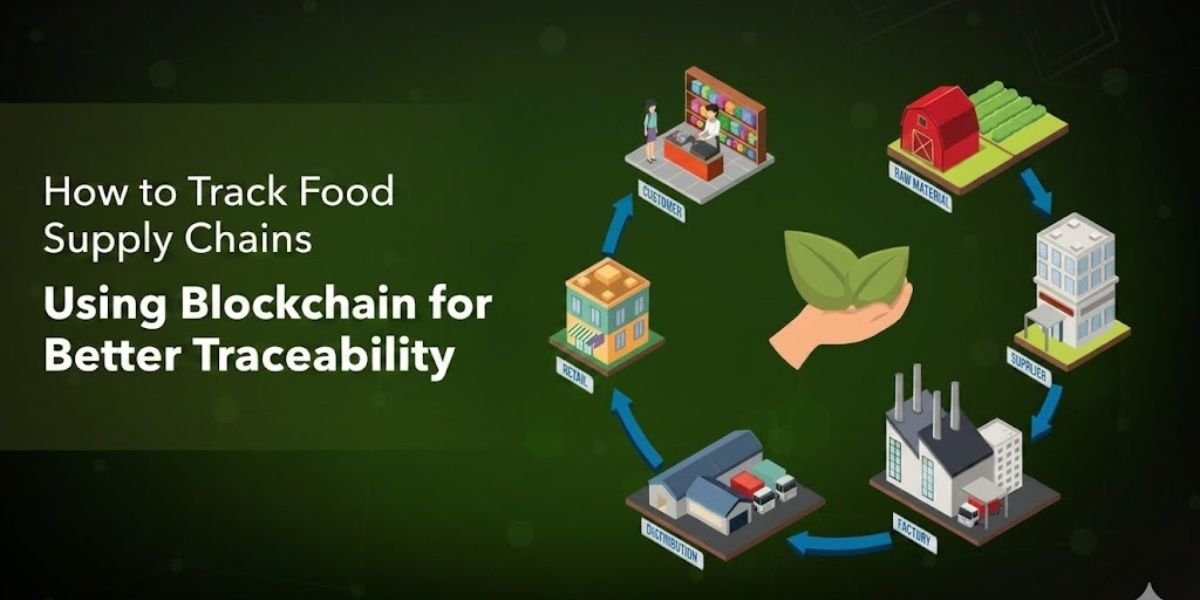
Tracking food supply chains via blockchain involves creating an immutable, decentralized record of every transaction from seed to shelf. By integrating IoT sensors and RFID tagging, stakeholders can verify origin, monitor storage temperatures, and confirm logistical handoffs in real-time. This eliminates data silos and ensures that food safety recalls can be executed in seconds rather than weeks.
The modern food supply chain is a sprawling, fragmented network. In the United States alone, the average meal travels over 1,500 miles before reaching the consumer’s plate. During this journey, a single product may pass through dozens of independent entities, including farms, processors, cold storage facilities, and third-party logistics providers.
Historically, each of these participants maintained their own isolated ledgers, leading to a “visibility black hole” that complicates food safety and inventory management.
Recent data from the CDC suggests that foodborne illnesses affect approximately 48 million Americans annually. The financial and human cost of these incidents is exacerbated by slow, manual traceability systems.
Blockchain technology is emerging as the definitive solution to this crisis. By providing a shared, tamper-proof digital infrastructure, blockchain allows for the instantaneous verification of a product’s history.
This comprehensive guide explores the following core areas:
- The mechanics of digital food tracking and why visibility is a regulatory necessity.
- The operational role of distributed ledger technology in eliminating data manipulation.
- A step-by-step technical framework for implementing blockchain across the supply chain.
- Comparative analysis of blockchain versus legacy ERP and paper-based systems.
- The synergy between IoT, AI, and Blockchain for predictive logistics.
What Food Supply Chain Tracking Really Means
Food supply chain tracking is the systematic ability to reconstruct the history, use, or location of an item through documented identification. In the context of the FDA’s Food Safety Modernization Act (FSMA), specifically Section 204, tracking is no longer just a business advantage; it is a legal requirement for many high-risk food categories.
True end-to-end tracking encompasses four critical layers:
- Origin Tracking: This begins at the farm level, documenting the specific plot of land, the batch of seeds used, and the application of fertilizers or pesticides. This “first mile” data is crucial for organic and non-GMO certifications.
- Processing Records: As raw commodities move to processing plants, tracking must account for transformations. If bulk grain is turned into flour or raw meat is packaged, the system must maintain a “linkage” between the raw input and the finished batch ID.
- Logistical Conditions: This involves monitoring the environment during transit. For perishable goods, tracking must include continuous data points for temperature and humidity to ensure the cold chain remained intact.
- Retail and Delivery Verification: The final stage involves recording the specific retail location where the product was sold or the final delivery mile to the consumer. This completes the loop, allowing for a “surgical” recall if a specific batch is found to be contaminated.
Blockchain in Supply Chain Systems
Blockchain serves as a foundational layer of truth for supply chain participants. Unlike a traditional database managed by a single company, a blockchain is a decentralized ledger. This means that no single party—whether a massive retailer or a small-scale farmer, can unilaterally change the records once they are committed to the chain.
In a practical supply chain environment, every physical handoff is mirrored by a digital transaction. When a truck driver picks up a load of produce, a digital handshake occurs. The driver’s digital signature and the farm’s timestamp are etched into the ledger. Because this data is cryptographically secured, it becomes nearly impossible to commit fraud or misrepresent the age or origin of the food.
Furthermore, blockchain addresses the trust gap inherent in global trade. When multiple stakeholders work on a synchronized version of the truth, the need for time-consuming audits and manual reconciliations is significantly reduced. This leads to faster payments, fewer disputes, and a more resilient logistics network.
How to Track Food Supply Chains Using Blockchain
Implementing a blockchain tracking system requires a disciplined, multi-step approach that connects physical biological assets to digital records.
Step 1: Farm Data Capture
The process begins on the farm, where the Digital Twin of the food product is created. Farmers enter data regarding harvest dates and geographical coordinates. Modern systems often use mobile applications that automatically geo-tag the entry, ensuring the harvest location is indisputable. This initial data block serves as the anchor for all future entries in the chain.
Step 2: IoT + RFID Tagging
Once the product is harvested, physical identifiers are applied. RFID (Radio Frequency Identification) tags or high-capacity QR codes are attached to crates or pallets. These tags are linked to IoT sensors that monitor the product’s vitals.
For example, a pallet of berries might have a sensor that pings its temperature to the blockchain every ten minutes. If the temperature exceeds a safe threshold, an automated alert is triggered on the ledger.
Step 3: Processing Stage Logging
During processing, the “one-step-forward, one-step-back” rule is digitized. When a processor receives raw goods, they scan the RFID tag, which updates the blockchain with a receipt event. Any transformation (such as washing, slicing, or mixing) is logged under the same batch ID. This ensures that if a contamination occurs at the plant, investigators can instantly see which farms provided the raw material for that specific run.
Step 4: Transportation Tracking (Cold Chain Monitoring)
Logistics is often where visibility is lost. Blockchain-enabled trucks use GPS and integrated telematics to provide a real-time stream of location data to the ledger. This is especially vital for cold chain management.
By recording environmental data directly onto the blockchain, carriers can prove they maintained the required temperature throughout the entire journey, which is essential for insurance and safety compliance.
Step 5: Distribution & Retail Entry
As goods arrive at distribution centers and finally at retail stores, scanning events continue to update the blockchain. This allows the retailer to manage FEFO (First-Expired, First-Out) inventory systems with extreme accuracy.
By knowing the exact remaining shelf life of every pallet, retailers can reduce food waste by discounting items that are closer to their expiration dates based on actual blockchain data rather than generic estimates.
Step 6: Consumer Verification Layer
The final step empowers the end user. By scanning a QR code on the packaging with a smartphone, a consumer can access a simplified view of the blockchain record. They can see the name of the farm, the date it was picked, and even the safety test results for that specific batch. This transparency builds immense brand loyalty and fulfills the modern consumer’s demand for “clean label” transparency.
Blockchain Traceability in the Food Industry
The transition of blockchain from a theoretical concept to a mainstream tool is already visible through major corporate adoptions. These are not merely pilot programs but large-scale operational shifts.
- Walmart and IBM Food Trust: Walmart famously utilized blockchain to track the origin of mangoes and leafy greens. Previously, tracing a sliced mango back to its farm took approximately seven days. With blockchain, that time was reduced to 2.2 seconds.
- Nestlé: This global giant uses blockchain to provide transparency for its Mousline purée in France and its coffee sourcing. They leverage the technology to prove fair trade practices and sustainable farming methods.
- Carrefour: As a major European retailer, Carrefour has implemented blockchain for over 30 product lines, including eggs, cheese, and milk. They reported a significant increase in sales for blockchain-tracked items, proving that consumers value and reward transparency.
These examples highlight that blockchain is the new standard for supply chain resilience. It provides the infrastructure needed to isolate a contaminated product within seconds, potentially saving lives and preventing the mass disposal of safe food during broad, non-specific recalls.
Blockchain Food Traceability vs Traditional Tracking Systems
To understand why the industry is shifting, one must look at the structural failures of traditional tracking. Legacy systems are built on siloed architecture, where each company maintains its own private database. Information is exchanged via manual entry, paper invoices, or basic Electronic Data Interchange (EDI).
The primary weakness of this model is the latency of data. If a contamination occurs, investigators must contact each party in the chain, wait for them to pull records, and then manually reconcile those records with the next link. This creates a “one-step-up, one-step-back” visibility that is slow and prone to human error.
Blockchain-based systems replace this fragmented approach with a Unified Ledger.
| Feature | Traditional Systems | Blockchain Systems |
| Data Storage | Centralized, isolated databases | Decentralized, shared ledger |
| Trust Model | Trust is required between parties | Trust is built into the protocol |
| Transparency | Limited; data is hidden by silos | High; authorized parties see full history |
| Recall Speed | Days to weeks | Seconds to minutes |
| Data Integrity | Vulnerable to manual alteration | Immutable and tamper-resistant |
In a blockchain environment, trust is algorithmic. You don’t need to trust that a supplier didn’t change the date on a paper form; you trust the cryptographic hash and the timestamp that was recorded the moment the harvest happened.
Blockchain in Food Supply Chain Management
Modern supply chain management (SCM) involves more than just moving boxes; it is the management of information and financial flows. Blockchain introduces significant optimizations to these administrative layers.
- Inventory Accuracy: Because every update is real-time and synchronized, the system provides a “live” view of inventory across the entire network. This reduces the need for safety stock and minimizes the risk of stockouts or over-ordering, which are major drivers of food waste in the United States.
- Surgical Recalls: This is perhaps the most critical benefit. During a typical recall, retailers often pull all products of a certain type (e.g., all romaine lettuce) because they cannot quickly identify the specific contaminated batch. Blockchain allows for surgical recalls, where only the affected batch is removed. This saves millions of dollars in discarded inventory and protects the brand’s reputation.
- Fraud and Adulteration Prevention: Food fraud, such as mislabeling conventional produce as “Organic” or substituting expensive fish with cheaper varieties, costs the global industry an estimated $40 billion annually. Blockchain makes this nearly impossible by creating an unbroken chain of custody that verifies the product’s identity at every handoff.
Food Supply Chain Logistics and Real-Time Monitoring
In the logistics sector, the integration of blockchain with IoT (Internet of Things) creates a “smart” supply chain. This is particularly vital for Food Supply Chain Logistics involving perishable goods.
Logistics providers now use Smart Contracts to automate the handoff process. For example, a smart contract can be programmed to release payment to a carrier only if the Cold Chain Monitoring data proves the cargo remained between 2°C and 4°C throughout the trip. If a temperature violation is recorded on the blockchain, the contract can automatically trigger an insurance claim or flag the batch for inspection.
This real-time monitoring turns logistics from a passive delivery service into an active quality assurance layer. It ensures that “first-mile” quality is preserved until the “last-mile” delivery.
Blockchain, IoT, and AI in Next-Generation Traceability Systems
The future of food safety lies in the convergence of blockchain, IoT, and artificial intelligence. Together, they create a predictive and autonomous traceability ecosystem.
- IoT devices act as the nerves by continuously sensing and collecting data from farms and transport vehicles. Blockchain acts as the memory by storing that data in an unchangeable and secure format.
- AI systems then act as the brain by analyzing this information to detect risks and predict failures. If a temperature spike is detected in a refrigerated shipment, AI can identify the risk and blockchain records the event permanently.
- Logistics systems can then automatically reroute the delivery to prevent spoilage. Because the data is pulled from a blockchain, the conclusions of the AI are based on verified and high integrity data.
For instance, if AI detects a pattern of rising temperatures in a specific shipping route during certain times of the year, it can suggest route optimization to avoid spoilage. Because the data it analyzes is pulled from a blockchain, the AI’s conclusions are based on verified, high-integrity data, rather than corrupted or incomplete records.
Challenges in Blockchain-Based Food Supply Chains
Despite the clear advantages, the road to universal adoption has obstacles. It is important for stakeholders to recognize these hurdles before implementation:
- Implementation and Integration Costs: Setting up the infrastructure and purchasing IoT sensors can be expensive. Additionally, many companies struggle with legacy system integration, trying to make a 20-year-old ERP system talk to a modern blockchain protocol.
- Onboarding Small-Scale Suppliers: A blockchain is only as strong as its weakest link. If small farms lack the digital literacy or equipment to record data, the chain is broken. This requires a standardized data format and user-friendly mobile interfaces to ensure total participation.
- Consensus and Governance: Deciding who has permission to view certain data and who manages the network is a complex legal and technical hurdle. Most industry leaders are moving toward Private (Permissioned) Blockchains to maintain a balance between transparency and competitive privacy.
The Future of Food Supply Chain Traceability
The future of food traceability is moving toward fully digital and interoperable systems. Regulatory bodies (FDA in the U.S. and the EFSA in Europe) are increasingly focusing on faster and more transparent recall systems to meet modern safety standards.
Blockchain based automation is expected to play a major role in meeting these requirements. Consumer expectations are also changing, with more demand for transparency about food origin and production methods.
Over time, verifying food origin digitally may become as standard as checking nutritional labels today. This will reward ethical producers and ensure a higher level of safety for the global food supply.
Conclusion
The evolution of the food supply chain is moving away from fragmented and trust dependent systems toward unified digital networks. How to track food supply chains using blockchain is no longer a theoretical question but a practical reality for industry leaders.
By implementing blockchain food traceability, businesses can ensure real time visibility and surgical precision during recalls. This technology effectively bridges the gap between different stakeholders and provides a single version of the truth for every product.
While challenges like cost and system integration still exist, the benefits of improved safety and operational efficiency are undeniable. Blockchain is becoming a foundational technology that ensures the resilience of the entire food industry.
The ultimate goal of these systems is to build lasting brand trust and protect public health. As adoption grows, digital transparency will become the new global standard for every meal we consume.
FAQ
What is blockchain food traceability?
It is a digital system where every event in a food product’s life (from harvest to retail) is recorded on a permanent, shared ledger that cannot be altered or deleted.
How does blockchain improve food supply chain tracking?
It removes data silos. Instead of separate companies having separate records, everyone uses the same ledger, making it possible to track a product’s entire history in seconds.
Why is food traceability important in the USA?
It is critical for complying with FDA (FSMA) regulations, reducing the impact of foodborne illnesses, and meeting consumer demands for transparent sourcing.
What industries use blockchain for food tracking?
Major retailers (like Walmart), global manufacturers (like Nestlé), logistics companies, and specialized agricultural exporters.
Is blockchain widely used in food supply chains today?
Yes. While it began as a pilot technology, it is now used daily by global industry leaders to track everything from leafy greens to seafood and coffee.
What are the main challenges of blockchain adoption?
The primary barriers are high initial costs, the difficulty of integrating with old software, and the need for all suppliers in the chain to participate.
What is the future of blockchain in food supply chains?
The future is an automated, real-time ecosystem where AI, IoT, and Blockchain work together to predict safety risks and eliminate food waste before it happens.