Operational technology (OT) environments have transformed into prime targets for sophisticated cyberadversaries. Manufacturing plants, electrical power grids, oil refineries, water treatment facilities, pharmaceutical factories, and modern transportation systems all depend on complex industrial control systems (ICS) to sustain physical operations safely. As these historically isolated environments converge with corporate enterprise IT networks, the attack surface expands exponentially, creating an urgent need for deep visibility into cyber threats without introducing risks that could disrupt critical real-time operations.
A Security Information and Event Management (SIEM) platform serves as the central nervous system for security telemetry within these environments. By collecting security logs from vastly different systems, correlating disjointed events, and isolating anomalous behavior, a SIEM empowers security operations centers (SOC) to intercept threats before they cross the line into physical disruption. While legacy SIEM architectures were built strictly around corporate enterprise parameters, modern leading platforms have adapted to support the unique requirements of industrial control networks, Supervisory Control and Data Acquisition (SCADA) systems, programmable logic controllers (PLCs), and proprietary industrial automation protocols.
Selecting the best SIEM for operational technology requires moving past generic feature lists and checking for deep, specialized operational alignment. The ideal solution must parse low-level industrial protocols, integrate natively with specialized OT network monitoring tools, streamline rigorous regulatory compliance workflows, and operate passively to eliminate the risk of operational disruption.
What Is SIEM in an Operational Technology Environment?
A Security Information and Event Management (SIEM) platform acts as a centralized data engine designed to ingest, normalize, analyze, and retain security event data generated across the enterprise. In an OT landscape, the data ingestion footprint expands past standard office workstations to include a diverse mix of engineering and physical automation components.
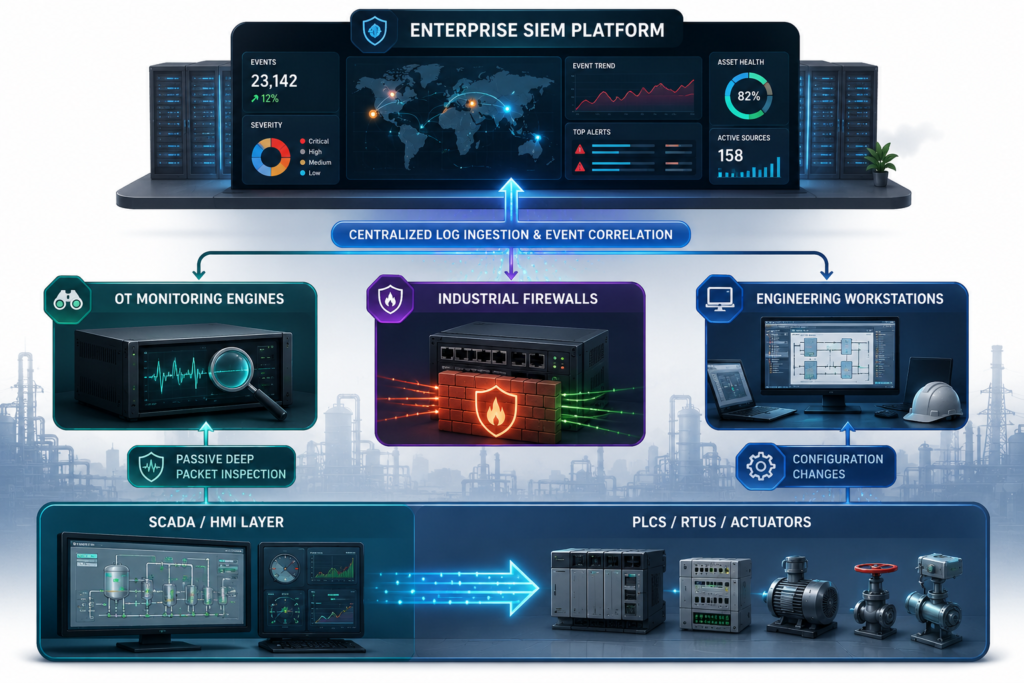
To deliver comprehensive visibility, a well-configured OT SIEM aggregates event logs from distinct sources across the Purdue Model architecture:
- Industrial Firewalls and Border Gateways: Boundary protection devices managing the strict segmentation between IT and OT zones.
- Engineering Workstations: The high-privilege computers utilized by automation engineers to modify control logic and push firmware updates.
- Programmable Logic Controllers (PLCs) and Remote Terminal Units (RTUs): The hardware microcomputers that directly read physical sensors and execute physical machinery commands.
- SCADA Servers and Human-Machine Interfaces (HMIs): The central software visualization platforms and operator consoles used to monitor and manage industrial processes.
- Core Infrastructure Logs: Internal event tracking from Windows servers, Active Directory domain controllers, industrial network switches, secure remote access gateways, and host-level endpoint security agents.
- Specialized OT Network Monitoring Platforms: Dedicated passive inspection engines that continuously analyze industrial network traffic.
Relying on manual analysis for millions of daily log entries across these distinct domains is impossible. The SIEM eliminates this blind spot by applying correlation rules and behavioral models to surface patterns that indicate coordinated malicious activity.
For instance, if an engineer’s Active Directory account successfully logs into a safety zone HMI outside of scheduled maintenance hours, the event by itself might seem normal. However, if the SIEM instantly pairs that login with an unscheduled PLC ladder logic modification occurring at the same time, it elevates the correlation to a high-severity alert, giving the security team early notice of a potential insider threat or compromised remote access session.
Why OT Requires a Different Approach Than Traditional IT SIEM
Industrial automation environments operate under entirely different performance metrics and constraints compared to traditional corporate offices. Enterprise IT networks focus heavily on confidentiality and data privacy, whereas OT environments prioritize physical safety, system availability, and uninterrupted uptime above all else.
A standard corporate computer can easily tolerate an aggressive vulnerability scan, a sudden endpoint isolation action, or a midday reboot to apply a critical security patch. In contrast, performing an active scan on a sensitive PLC or forcing an unplanned restart on a live production line can trigger catastrophic hardware failure, result in millions of dollars in lost production, or create severe physical safety hazards for plant operators.
| Architectural Metric | Enterprise IT Environments | Operational Technology (OT) Environments |
| Primary Priority | Data Confidentiality & Privacy | Physical Safety & Continuous Availability |
| Operational Lifespan | Rapid hardware turnover (3–5 years) | Long-term capital assets (15–30+ years) |
| Protocol Standards | Standardized open protocols (HTTP, TCP/IP, DNS) | Proprietary, legacy industrial protocols (Modbus, DNP3) |
| Patching Windows | Frequent, automated monthly cycles | Rare, highly constrained annual/bi-annual shutdowns |
| Telemetry Access | Active scanning, host agents, and log forwarding | Passive network sniffing and centralized integration |
Because many legacy industrial components lack the computing power to run security software or generate standard event logs, standard IT monitoring approaches fall short. A robust OT deployment strategy must avoid active network probing. Instead, the SIEM should operate as an analytics layer that receives rich telemetry from specialized, non-intrusive OT security platforms that safely mirror and inspect network traffic.
Key Features to Look for in the Best SIEM for Operational Technology
Evaluating a security platform for critical infrastructure requires verifying specific functional features that bridge the gap between IT security analytics and heavy industrial processes.
Industrial Protocol Visibility
A capable solution must process data from networks using specialized industrial protocols. Without deep parsing capabilities, critical control commands look like generic data packets, leaving the security team blind to unauthorized changes. The platform or its integrated ingestion engines must understand:
- Modbus TCP: The open master-slave protocol is widely used across manufacturing automation.
- DNP3 (Distributed Network Protocol): The standard protocol powering electrical utilities and water management systems.
- OPC UA: The cross-platform framework used for secure industrial machine-to-machine data exchange.
- IEC 60870-5-104 & IEC 61850: International telecontrol and substation automation standards governing electrical power grids.
- PROFINET & EtherNet/IP: High-speed industrial Ethernet protocols used for real-time control loop automation on factory floors.
Integration with OT Security Platforms
Rather than connecting directly to sensitive physical assets, the SIEM should pull rich data from dedicated OT monitoring tools. The platform must offer built-in connectors for leading industrial security tools, including Nozomi Networks, Claroty, Dragos, Microsoft Defender for IoT, and Armis. This design allows the SIEM to serve as the unified dashboard while using the deep asset discovery and threat detection features of these specialized platforms.
Real-Time Correlation Across IT and OT
Modern industrial cyberattacks rarely target the control network out of nowhere; they typically begin with an initial corporate network breach, credential theft, or a compromised remote access session. The platform must correlate cross-domain events in real time. It should link a corporate phishing alert or an unusual virtual private network (VPN) login with subsequent engineering workstation modifications or anomalous PLC commands down on the plant floor.
Compliance Reporting and Mapping
Industrial operators face growing regulatory oversight and strict framework audits. The platform should offer pre-built compliance reporting modules that map event logs directly to major regulatory standards. This includes IEC 62443 for industrial automation, the NIST Cybersecurity Framework (CSF) for critical infrastructure, NERC CIP for bulk electric systems, and ISO/IEC 27001 for broad security management.
Long-Term Log Storage and Search Performance
Regulatory investigations and root-cause analyses in industrial settings often require looking back months or even years. The platform must offer an architecture that supports long-term data retention without hurting search speeds. This allows analysts to run historical queries over multi-year datasets during post-incident investigations without slowing down real-time threat detection.
Best SIEM for Operational Technology: 7 Leading Platforms
1. Splunk Enterprise Security
Splunk Enterprise Security stands out as an industry-standard analytics platform used by large industrial enterprises, global manufacturers, and critical infrastructure operators. Its core strength lies in its highly flexible search language and its ability to ingest and analyze massive volumes of unstructured machine data from both IT and OT infrastructure.
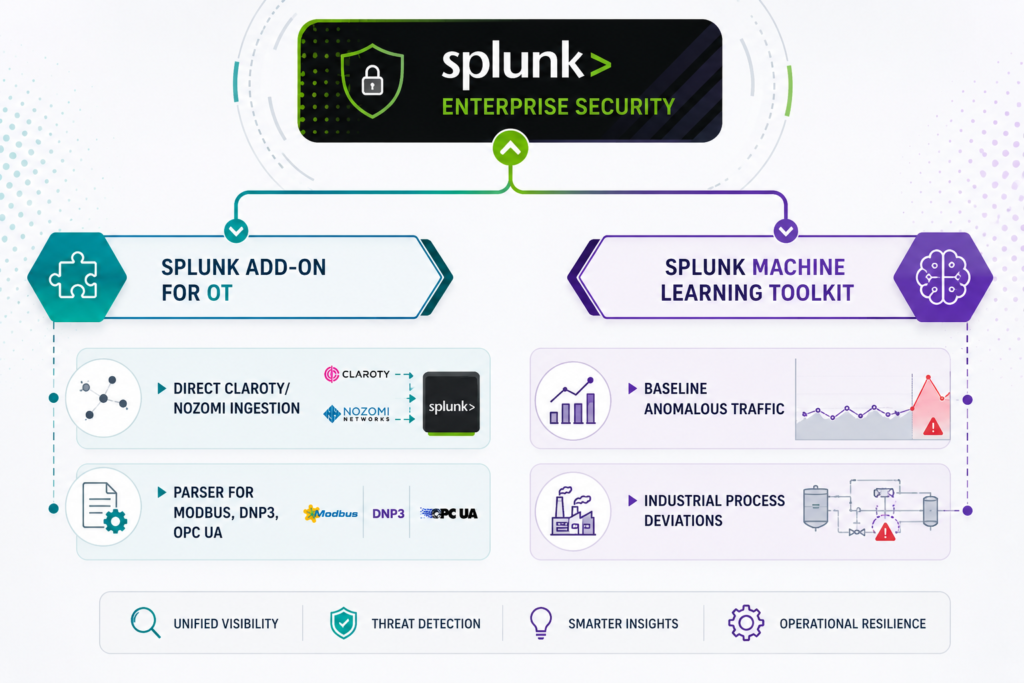
The platform uses the Splunk Add-on for Operational Technology along with application-specific integrations to map industrial logs to the Splunk Common Information Model (CIM). This allows security teams to use the platform’s advanced correlation engine and machine learning tools to track down hidden anomalies across complex operations.
Splunk is highly effective at building custom visualization dashboards. This feature lets asset owners view real-time operations alongside security metrics on a single screen.
- Best Suited For: Large-scale manufacturing conglomerates, multi-regional energy utilities, oil and gas operations, and global enterprises running unified, multi-tier SOC facilities.
2. Microsoft Sentinel
Microsoft Sentinel is a cloud-native platform that changed how organizations approach log collection by removing the need to manage on-premises server infrastructure. For industrial organizations with hybrid environments, Sentinel provides an easy deployment path through its native integration with Microsoft Defender for IoT.
The platform uses cloud scalability and built-in automation routines driven by machine learning to analyze massive volumes of security data. Organizations already using the Microsoft Azure ecosystem can take advantage of one-click data connectors to pull logs from enterprise systems, identity services, and industrial networks without complex configuration.
Sentinel helps streamline incident handling by automatically combining separate alerts across IT and OT systems into single, well-organized incident files.
- Best Suited For: Hybrid organizations heavily invested in the Microsoft Cloud ecosystem and operations using Microsoft Defender for IoT for passive asset tracking.
3. IBM QRadar
IBM QRadar is a mature, reliable choice for protecting critical infrastructure. It is well-regarded for its built-in asset tracking features and its advanced Sense Analytics engine, which excels at finding meaningful patterns across high-volume log streams.
Instead of flooding security analysts with separate, disconnected alerts, QRadar groups related events into single investigations called Offenses. The platform natively processes flow logs and network events, giving security teams deeper visibility into network behavior even when traditional device logs are unavailable.
QRadar offers out-of-the-box support for major industrial security platforms, making it easier to parse network data from SCADA environments and industrial control networks.
- Best Suited For: Highly regulated critical infrastructure installations, government defense contractors, and large manufacturing operations requiring structured, compliance-focused alert management.
4. Google Security Operations
Google Security Operations (formerly Chronicle) is a cloud-native security platform engineered for high-speed search capabilities and large-scale data retention. It uses Google’s core search architecture to ingest, index, and analyze massive volumes of security telemetry in real time.
The platform stands out with its predictable pricing model, which decouples ingestion volume from licensing costs. This allows asset-heavy industrial environments to collect comprehensive logs from all PLC, HMI, and network components without worrying about budget overruns.
Google Security Operations automatically enriches incoming log data with global threat intelligence, helping security analysts quickly spot known threat actor infrastructure attempting to access OT networks.
- Best Suited For: Enterprise-scale industrial operations generating immense daily log volumes and organizations pursuing a cloud-first security analytics strategy.
5. LogRhythm SIEM
LogRhythm SIEM focuses on usability and structured workflows, combining log management, user entity analytics, and automated response playbooks into a single platform. It uses a structured processing engine called the Machine Data Importer Engine (MDI) to clean, normalize, and add context to incoming data at the moment of ingestion.
This automated parsing ensures that unusual changes to OT devices are immediately categorized with the correct severity levels. LogRhythm also includes pre-packaged compliance automation modules tailored to industrial standards, helping organizations significantly reduce the time spent preparing for regulatory audits.
The platform features built-in orchestration tools that allow teams to create customized response playbooks, ensuring consistent incident handling across different facilities.
- Best Suited For: Mid-market to large industrial manufacturers, municipal utilities, and security teams looking for out-of-the-box compliance reporting and guided response workflows.
6. Exabeam Security Operations Platform
Exabeam specializes in User and Entity Behavior Analytics (UEBA), focusing heavily on tracking down insider threats and compromised accounts. Rather than relying solely on rigid, pre-defined detection rules, the platform builds baseline behavioral profiles for every user, machine, and engineering workstation across the environment.
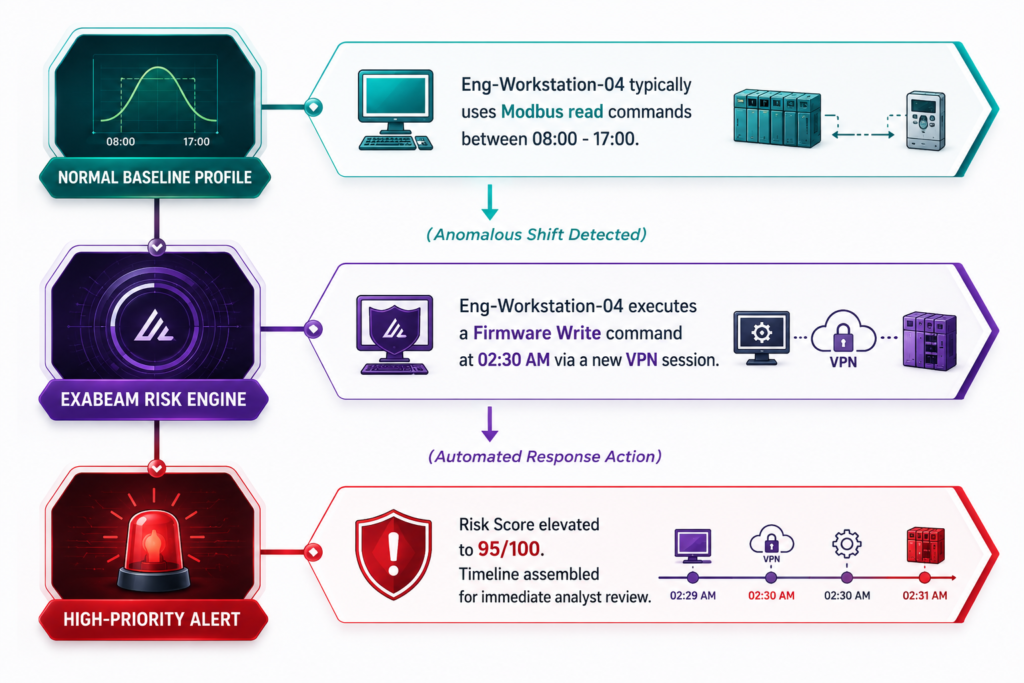
The platform automatically compiles scattered event logs into clear chronological timelines, allowing analysts to quickly understand the exact sequence of an incident. In an industrial context, this capability helps security teams spot subtle, unauthorized configuration changes made by an insider or an external attacker using stolen credentials.
- Best Suited For: Organizations focused on detecting insider threats, compromised remote maintenance sessions, and high-privilege account misuse across critical industrial control environments.
7. Elastic Security
Elastic Security is built on the open Elastic Stack (ELK), providing a flexible, highly customizable environment that appeals to mature security teams. The platform combines log management, endpoint protection, and security analytics into a fast, search-focused architecture.
Its open-source heritage means it lacks the restrictive vendor lock-in common with proprietary platforms, allowing teams to build custom data parsers for rare, proprietary industrial protocols. Elastic offers a clear roadmap for organizations that want to build bespoke dashboards and tailor-made detection logic for highly specialized automation environments.
The platform’s distributed design makes it easy to scale storage across separate regional manufacturing sites and central operations centers.
- Best Suited For: Organizations with internal security engineering expertise and budget-conscious industrial companies looking for a highly scalable, open platform architecture.
SIEM Alone Is Not Enough
Deploying a platform does not automatically secure an industrial operation. A common misconception among asset owners is treating the platform as a complete silver bullet for OT security. In practice, a platform is strictly an analytics engine; its effectiveness depends entirely on the quality, relevance, and depth of the data feeds it receives from other security layers.
A modern, resilient defense architecture requires a layered approach across the entire operational footprint:
- Network Segmentation: Enforcing strict physical and logical separation between corporate IT networks and production OT environments using the Purdue Model framework.
- Industrial Firewalls: Implementing specialized firewalls capable of performing deep packet inspection on industrial protocols to block unauthorized control commands.
- OT Asset Discovery: Deploying continuous, passive network sniffers to map out every asset on the network without interrupting live processes.
- Vulnerability Management: Tracking known weak spots and firmware vulnerabilities across PLCs and HMIs using passive analysis rather than active network scanning.
- Multi-Factor Authentication (MFA): Enforce strict, token-based authentication for all remote maintenance connections and jumps between the IT and OT zones.
- Endpoint Detection and Response (EDR): Deploying specialized, low-overhead security agents on engineering workstations and SCADA servers where compatible.
- Incident Response Planning: Developing clear, rehearsed response steps designed specifically for industrial environments to isolate cyber threats while keeping physical processes running safely.
The platform acts as the central hub that connects these separate layers. Without these underlying security controls, it has no meaningful telemetry to analyze, leaving the organization exposed to blind spots.
Real-World Industrial Cyber Incidents That Highlight the Need for SIEM
Colonial Pipeline (2021)
One of the most disruptive cyber incidents affecting critical infrastructure occurred when Colonial Pipeline suffered a devastating ransomware attack executed by the DarkSide group. The attackers gained entry into the corporate IT network by compromising a legacy VPN profile that lacked multi-factor authentication. While the ransomware infection was confined to business and billing systems, management chose to shut down pipeline operations to prevent the threat from spreading into operational control networks.
This multi-day shutdown triggered fuel shortages and price spikes across the United States East Coast. The incident underscored how a security breach in corporate IT systems can severely impact physical operations, highlighting the clear need for a centralized platform to monitor data movements and spot early signs of lateral travel across the IT-OT boundary.
Norsk Hydro (2019)
Global aluminum producer Norsk Hydro fell victim to a wide-ranging LockerGoga ransomware attack that crippled its corporate infrastructure. The infection spread rapidly across the company’s global network, forcing operators to switch multiple manufacturing facilities to manual operations and standalone analog workflows to maintain production.
The financial impact surpassed US$70 million, driven by production delays, cleanup expenses, and lost business operations. This incident highlighted the vital importance of having centralized log collection, rapid correlation engines, and coordinated incident response playbooks capable of handling fast-moving threats across both enterprise networks and industrial manufacturing plants.
Triton / Trisis Malware (2017)
The Triton (also known as Trisis) malware targeted safety instrumented systems (SIS) at a petrochemical plant in Saudi Arabia, marking a dangerous shift in industrial cyber threats. Rather than focusing on data theft or simple extortion, the attackers specifically targeted Schneider Electric Triconex safety controllers, which are designed to prevent catastrophic physical accidents.
The malware modified memory code on the safety controllers, aiming to disable safety overrides and potentially cause physical damage or asset failure. A central platform integrated with deep OT monitoring tools can detect early warning signs of this type of attack by spotting unusual engineering workstation activity, unauthorized controller read/write commands, and unexpected changes to safety system states.
How Different Industries Use SIEM
Manufacturing
Automotive, aerospace, and consumer goods factories use central monitoring platforms to track activity across production lines, assembly robots, and engineering stations. The analytics engine watches for unauthorized logic modifications, unusual configuration changes, and rogue hardware attachments on the shop floor to prevent costly production line stoppages.
Energy and Utilities
Electrical generation, transmission, and distribution operators rely on centralized platforms to collect logs from regional substations, SCADA servers, and RTUs. The system monitors for suspicious control actions, like unauthorized circuit breaker commands or unusual configuration changes, that could threaten grid stability or interrupt power delivery.
Oil and Gas
Upstream drilling sites, midstream pipelines, and downstream refineries use centralized security monitoring to protect widely distributed field devices. The platform analyzes event logs from remote monitoring stations and pumping installations to catch early signs of tampering or unauthorized access that could create safety hazards or interrupt supply lines.
Water and Wastewater Treatment
Water utilities integrate their automated pumping stations, filtration controls, and chemical dosing systems with a central security analytics platform. The engine is tuned to spot unauthorized adjustments to chemical levels, invalid pump override commands, or unusual remote connection attempts that could threaten public water safety.
Pharmaceuticals
Drug manufacturers rely on central platforms to protect sensitive recipe databases, cleanroom environments, and automated batch production systems. The platform monitors for any unauthorized access to data or alterations to manufacturing processes, helping teams maintain product quality and verify compliance with strict healthcare regulations.
How to Choose the Right SIEM for Your OT Environment
Choosing the right platform for an industrial environment requires looking beyond generic IT features and focusing on the operational realities of the plant floor.
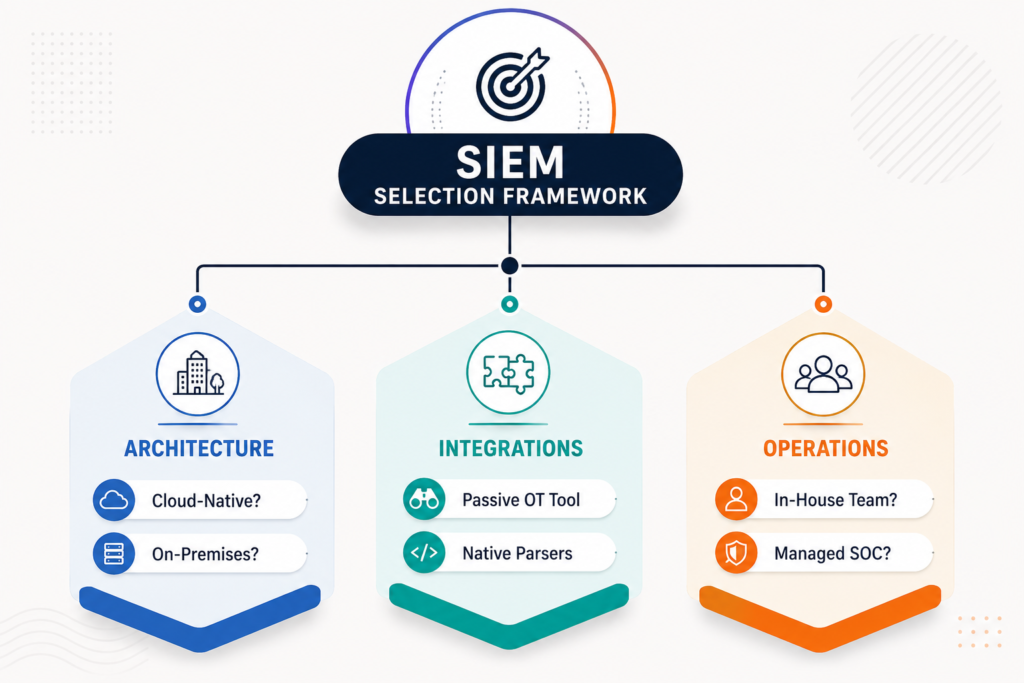
Asset owners should evaluate several key factors during the selection process:
- Integration Support: Confirm the platform provides native, out-of-the-box parsers for your existing passive OT security tools and industrial firewalls.
- Deployment Architecture: Decide whether a cloud-native platform fits your corporate strategy or if isolated, on-premises log storage is required to meet strict local security policies.
- IT-OT Correlation Capabilities: Ensure the correlation engine can easily link events from corporate Active Directory systems with low-level industrial control network alerts.
- Compliance Framework Support: Check that the platform includes pre-packaged reporting templates for the specific regulations governing your industry, such as NERC CIP or IEC 62443.
- Operational Resource Fit: Choose a platform that matches your team’s skillset; complex engines with open architectures offer great flexibility but often require dedicated engineers to maintain effectively.
Large organizations with fully staffed, round-the-clock security operations centers often prefer highly customizable platforms like Splunk Enterprise Security or Elastic Security to build tailor-made detection rules. Conversely, smaller internal teams or municipal utilities usually find better value in cloud platforms like Microsoft Sentinel or platforms with built-in automation like LogRhythm, which deliver strong threat detection out of the box without requiring a large engineering team to manage the infrastructure.
Frequently Asked Questions
What is the best SIEM for operational technology?
There is no single best option that fits every organization. Splunk Enterprise Security, Microsoft Sentinel, IBM QRadar, Google Security Operations, LogRhythm, Exabeam, and Elastic Security are all top-tier platforms for industrial settings. The right choice depends on your current network setup, available budget, compliance mandates, and how well the platform integrates with your existing OT security tools.
Can a traditional SIEM monitor industrial control systems?
Yes, but it cannot do it alone. Standard platforms lack native visibility into industrial control systems and cannot safely poll physical hardware. They require integration with specialized, passive OT network monitoring platforms that capture, parse, and forward industrial security telemetry without risking operational disruption.
Is SIEM enough to protect operational technology?
No. A platform provides centralized monitoring, log retention, and event correlation, but it does not directly block threats. A complete industrial security strategy requires additional defense layers, including strong network segmentation, passive asset discovery, industrial firewalls, multi-factor authentication, and tailored incident response plans.
Which industries benefit the most from OT SIEM?
Any industry operating critical infrastructure benefits significantly from an OT deployment. This includes manufacturing, power generation, water utilities, oil and gas operations, pharmaceutical production, mining, and public transportation networks, where cyber incidents can lead to physical safety hazards or major economic losses.
What is the difference between SIEM and OT network monitoring?
A platform collects, stores, and correlates security logs from many different sources across both the corporate IT and operational OT networks. An OT network monitoring tool operates directly inside the industrial network, using passive packet inspection to discover physical assets, decode industrial protocols, and track operational behavior. Most mature organizations use both tools together, feeding detailed OT network telemetry directly into the central platform.
Can small manufacturers use SIEM?
Yes. Cloud-native options like Microsoft Sentinel or open architectures like Elastic Security make it easier for smaller manufacturers to start monitoring their systems without massive upfront hardware costs. Smaller operations often pair these platforms with managed security services to handle day-to-day alert monitoring without needing a large internal team.