Operational technology forms the foundational framework for industrial infrastructure globally, ensuring that physical processes run safely, efficiently, and predictably. This hardware stack underpins electricity generation in power grids, complex chemical synthesis in pharmaceutical facilities, discrete precision assembly in automotive factories, and continuous filtration in municipal water treatment plants. Unlike enterprise information systems, the primary function of operational equipment is direct monitoring and deterministic control over physical plant equipment.
Modern industrial companies are significantly scaling up capital expenditure on advanced operational hardware to support deep machine connectivity. Continuous tracking by the International Data Corporation confirms that worldwide spending on industrial automation and connected physical endpoints continues to climb year over year, with manufacturers allocating capital specifically to predictive maintenance infrastructure and unified digital tracking. Concurrently, industrial cybersecurity hardening has converged with production uptime as a primary engineering priority, heavily catalyzed by a historical rise in sophisticated cyber campaigns targeting critical national infrastructure.
Selecting the optimal operational technology components has shifted from a localized procurement task into a complex system engineering decision. Hardware choices directly affect mean time between failures metrics, plant workforce safety boundaries, regulatory compliance outcomes, long-term lifecycle maintenance spending, network attack surfaces, and future factory scalability. This detailed reference guide evaluates the essential hardware classes across modern production environments, their specific industrial use cases, and key technical factors required for strategic equipment selection.
Understanding Operational Technology Devices
Operational technology devices are specialized, ruggedized hardware systems engineered to directly interface with physical industrial processes. The fundamental differentiator between traditional enterprise information technology and operational technology lies in their core objectives; information technology architectures optimize data processing, business workflows, and static data storage, whereas operational technology equipment physically manipulates mechanisms, monitors thermodynamic states, tracks kinetic motion, and automates physical field operations.
This industrial equipment is designed for continuous, round-the-clock service over decades under extreme physical stress. Standard operating environments require hardware to withstand high thermal variation, airborne particulate matter, heavy mechanical vibration, constant ambient humidity, and severe electromagnetic interference from nearby heavy electrical machinery.
The primary industrial sectors dependent on robust operational technology deployments include:
- Discrete manufacturing and robotic assembly plants
- Upstream, midstream, and downstream oil and gas processing facilities
- Base-load, peak-load, and nuclear electric power generation stations
- Subsurface and open-pit mining operations
- Municipal water purification and wastewater treatment networks
- Highly validated pharmaceutical cleanroom production environments
- High-volume food, beverage, and agricultural processing lines
- Intermodal transportation, switching hubs, and railway networks
- Continuous-flow chemical and polymer processing plants
- Utility-scale wind, solar, and battery storage energy facilities
A single industrial facility often aggregates thousands of these interconnected hardware nodes, all communicating across specialized physical layers to maintain absolute process stability.
Programmable Logic Controllers (PLCs)
Programmable Logic Controllers serve as the primary execution engines for localized industrial automation. Developed in the late 1960s to completely replace rigid, failure-prone mechanical relay control panels, these solid-state computing platforms execute precise control logic routines with deterministic execution cycles measured in low milliseconds.
A controller functions by continuously scanning incoming electrical signals from field sensors, evaluating these data states against internally compiled control logic programs, and transmitting precise output voltages to actuate motors, valves, pumps, conveyors, and pneumatic cylinders.
Typical deployment areas include:
- Synchronized assembly line automation sequences
- High-speed sorting and packaging systems
- Multi-axis conveyor network coordination
- Kinematic tracking for industrial robotic arms
- Backwash timing cycles for water filtration systems
- Multi-stream chemical batch mixing sequences
Modern variants feature powerful processing units, embedded high-speed Ethernet interfaces, native support for industrial communication protocols, multi-processor hardware redundancy, granular remote diagnostics, and hardware-rooted cryptographic cybersecurity features.
The prominent global manufacturers leading this hardware sector include:
- Siemens with the SIMATIC S7 series
- Rockwell Automation through the Allen-Bradley ControlLogix and CompactLogix lines
- Schneider Electric via Modicon automation platforms
- Mitsubishi Electric with MELSEC series controllers
- Omron via Sysmac integrated automation controllers
- ABB through the AC800M and related controller series
These automation platforms represent exceptionally stable capital investments because of their hardened engineering, maintaining continuous operational lifespans that regularly exceed 15 years in unconditioned, high-vibration factory environments.
Distributed Control Systems (DCS)
Massive process facilities require unified management of tens of thousands of complex continuous control loops from a central framework. For these environments, Distributed Control Systems are an absolute technical requirement. Rather than utilizing a single, centralized processor that introduces a catastrophic single point of failure, a distributed control architecture separates processing duties across multiple sub-system controllers distributed geographically across a facility.
Industries requiring a dedicated distributed control environment include:
- Petrochemical and multi-stage oil refineries
- Utility-scale thermal, combined-cycle, and nuclear power plants
- Continuous-flow chemical and polymer synthesis plants
- Large-scale biological and chemical pharmaceutical formulation lines
- High-output pulp, paper, and paperboard mills
These distributed architectures focus specifically on controlling highly sensitive, interrelated physical process variables:
- Temperature gradients across multi-stage distillation columns
- Steady-state pressures inside high-pressure steam boilers
- Mass flow velocity parameters through cross-country distribution pipelines
- Chemical composition ratios within continuous stirred-tank reactors
- Rotational speed and excitation metrics for large steam and gas turbines
Implementing a modern distributed control platform provides high system availability through controller-level redundancy, seamless hot-swappable hardware replacement, deep fault tolerance, modular plant expansion capabilities, integrated historical data logging, and complete process visibility across multiple operator control rooms. Major international enterprise providers in this space include Honeywell, ABB, Emerson, Yokogawa, and Siemens.
Human Machine Interface (HMI) Panels
Human Machine Interfaces act as the primary visual interface between plant operators and underlying industrial control networks. By replacing antiquated, static mechanical gauges and physical control buttons with dynamic graphical displays, these panels deliver a centralized view of machine operations, active system alarms, real-time process statistics, and historical trend lines.
Modern industrial panel hardware provides:
- High-resolution, optically bonded industrial touchscreens
- Priority-based alarm categorization and historical logging
- Dynamic real-time process plotting and variable tracking
- Local machine diagnostic code interpretation
- Automated, shift-based production volume reporting
- Cryptographically secure remote monitoring and control capabilities
Plant operators leverage these panels to immediately isolate process anomalies and modify control parameters before minor variations cascade into production shutdowns. These visual interfaces are installed directly at the machine level alongside local controllers or integrated into broader distributed control architectures.
Supervisory Control and Data Acquisition (SCADA) Systems
Supervisory Control and Data Acquisition systems are engineered to monitor and manage industrial infrastructure spread over expansive geographic areas. While individual field controllers manage localized machinery in real time, a supervisory platform acts as an overarching management layer, collecting telemetry data from thousands of distant field nodes and delivering centralized operational control.
Geographically dispersed industries dependent on supervisory platforms include:
- Regional and national electrical transmission grids
- Municipal water collection, treatment, and distribution networks
- Long-distance crude oil and natural gas pipelines
- Regional rail networks and signaling infrastructure
- Utility-scale solar installations and wind energy farms
A comprehensive supervisory architecture relies on several interdependent components:
- Remote Terminal Units positioned at distant nodes
- Programmable Logic Controllers handling local processes
- Resilient wide-area industrial communication networks
- Central supervisory monitoring and data processing servers
- Multi-monitor operator workstations in central operations centers
- Central data historians optimized for high-write time-series storage
This multi-tiered infrastructure empowers utility operators and energy engineers to monitor physical asset health and adjust operational parameters across assets located thousands of kilometers away from headquarters.
Remote Terminal Units (RTUs)
Remote Terminal Units are highly ruggedized industrial computing nodes designed specifically for deployment at isolated field locations where permanent operator staffing is impossible. The primary engineering purpose of a remote unit is to collect local analog and digital sensor telemetry, compile the data packet, and transmit it securely across long distances to a central supervisory system.
These field units are built specifically for installation at:
- Unmanned oil and natural gas wellheads
- Dispersed wind turbine towers and meteorological masts
- Overland water pumping stations and lift facilities
- High-voltage electrical transmission substations
- Mainline pipeline valve and metering stations
Unlike standard computer hardware or standard indoor automation equipment, remote terminal units are engineered to operate flawlessly in unconditioned outdoor enclosures across ambient temperatures ranging from far below freezing to extreme desert heat. They feature low power consumption profiles, advanced noise rejection on signal inputs, and resilient communication controllers that maintain telemetry integrity over serial radio links, cellular networks, or satellite connections. Additionally, these units almost universally feature dedicated, intelligent battery backup charging systems to maintain full facility visibility during extended regional power blackouts.
Industrial Sensors
Modern industrial automation depends entirely on high-precision field sensors to bridge the physical and digital worlds. These instruments continuously capture physical phenomena and transform these measurements into standardized electrical currents or digital data streams parsed by control systems.
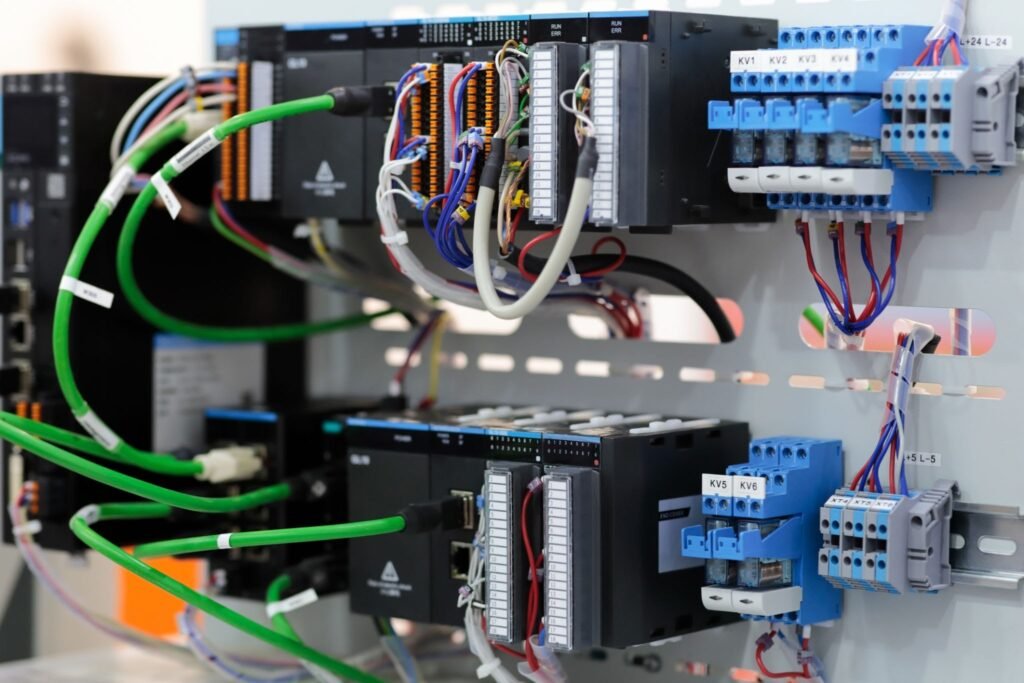
The fundamental physical variables tracked across industrial plants require distinct sensor types:
- Temperature: Monitored using heavy-duty thermocouples and Resistance Temperature Detectors inside industrial furnaces, chemical reactors, and food pasteurization vessels.
- Pressure: Evaluated via piezoresistive or capacitive pressure transducers to track hydraulic fluids, high-pressure steam lines, and vacuum chambers.
- Flow: Measured using electromagnetic, ultrasonic, or Coriolis mass flow meters to accurately track liquids, slurries, and gases moving through process piping.
- Proximity: Tracked via inductive, capacitive, or photoelectric proximity sensors to verify part positioning and count components on high-speed lines without physical contact.
- Vibration: Monitored using high-frequency industrial accelerometers fixed to motor housings, gearboxes, and pumps to identify mechanical misalignment or bearing wear.
- Level: Evaluated via continuous guided-wave radar, ultrasonic, or hydrostatic level transmitters to measure fluid and solid volumes inside storage tanks and processing silos.
- Gas Detection: Deployed via catalytic bead or electrochemical gas sensors to identify combustible vapors, toxic gas leaks, or oxygen deficiency, ensuring safety compliance.
Recent engineering breakthroughs in the Industrial Internet of Things space have led to the wide adoption of smart sensors that feature onboard microprocessors, enabling localized filtering, self-calibration, and secondary diagnostic data transmission alongside the primary process variable.
Industrial Robots
Industrial robotics have fundamentally re-engineered throughput capacities and workplace safety metrics across discrete manufacturing. Official census data published by the International Federation of Robotics reveals that the global operational stock of industrial robots has surpassed 4 million active units, reflecting an accelerating multi-year compound growth rate in automated manufacturing globally.
These articulating systems are deployed to execute high-speed, highly repeatable, or inherently dangerous tasks including:
- Multi-pass structural robotic welding
- Precision automotive clear-coat and paint spraying
- High-payload material handling and palletizing
- High-speed picking and structural packaging
- Micro-component electronic assembly
- Automated non-destructive quality inspection
Integrating robotic automation delivers high manufacturing throughput, repeatable dimensional tolerance execution, complete mitigation of workforce ergonomic strain, and a significant reduction in production scrap rates. Furthermore, collaborative robotics—widely known as cobots—have experienced widespread adoption due to their force-limiting sensor arrays and passive safety designs, which permit human operators to work directly alongside the machine without the space constraints of physical security cages or light curtains.
Variable Frequency Drives (VFDs)
Heavy industrial electric motors account for a dominant share of total global electrical energy consumption across manufacturing and utility operations. Variable Frequency Drives optimize these heavy power loads by dynamically altering the frequency and voltage supplied to an AC motor, matching its rotational speed exactly to real-time process demand rather than running it at maximum speed continuously.
Critical mechanical applications utilizing drive systems include:
- Large-scale centrifugal fluid pumps
- Industrial ventilation and induced-draft exhaust fans
- Rotary screw and reciprocating air compressors
- High-torque raw material assembly conveyors
- Commercial-scale HVAC chilling and air handling units
The core financial and engineering drivers for incorporating drive hardware include a significant reduction in factory electrical consumption, complete elimination of high inrush currents during motor startups, highly precise control over torque, reduced mechanical shock on gearboxes, and a corresponding extension of overall motor operating life. National energy efficiency mandates and carbon reduction frameworks have turned these drives into an absolute engineering standard across modern plant designs.
Industrial Ethernet Switches
Industrial communication networks demand specialized switching hardware engineered to handle physical and electrical conditions that would instantly destroy standard enterprise office switches.
Industrial network switches provide:
- Extruded aluminum or steel enclosures designed for DIN-rail mounting without internal cooling fans
- Dual, redundant direct-current power inputs to survive localized power supply failures
- High-performance internal switching fabrics optimized for real-time, low-latency industrial communication
- Granular Virtual Local Area Network configuration options for deterministic traffic routing
- Strict network segmentation capabilities to isolate control networks from business traffic
- Native hardware support for time-synchronization protocols and deep packet monitoring
These specialized components form the underlying communication matrix that links controllers, operator screens, supervisory servers, field sensors, and engineering laptops into a cohesive, high-speed local network.
Industrial Firewalls
Industrial cybersecurity has transformed from a niche engineering consideration into a core operational priority over the past decade. Landmark industrial cyber incidents—such as the Stuxnet malware discovered in 2010 which targeted specialized controllers, the Triton attack discovered in 2017 which directly compromised industrial safety controllers, and the Colonial Pipeline ransomware event in 2021 which paralyzed regional fuel distribution—have demonstrated that modern production environments are frequent targets for highly sophisticated threat actors.
Industrial perimeter firewalls protect vulnerable plant networks by:
- Enforcing strict ingress and egress traffic rules between plant zones
- Completely blocking unauthorized external or remote engineering access attempts
- Physically and logically segmenting production networks from corporate business networks
- Executing deep packet inspection on active industrial messaging traffic
- Restricting lateral threat movement if an individual plant asset is compromised
Unlike standard enterprise IT firewalls, industrial firewalls feature specialized software engines capable of reading and filtering industrial protocols, including Modbus, DNP3, PROFINET, EtherNet/IP, and OPC UA down to the specific command level. They are foundational blocks when designing a defense-in-depth architecture.
Safety Instrumented Systems (SIS)
Certain industrial processes involve highly volatile chemical reactions, extreme thermal states, or volatile pressures that present acute risks to human life and the surrounding environment. Safety Instrumented Systems function as entirely independent, isolated safety validation layers that operate completely separate from the standard control systems, with the sole purpose of automatically driving a facility into a safe state if an unmitigated emergency occurs.
Core functional safety implementations include:
- High-speed automated emergency shutdown systems
- Burner management safety validation systems for industrial furnaces
- Automated overpressure protection and fluid diversion valves
- Plant-wide toxic or combustible gas leak response isolation loops
- Automatic deluge and fire suppression activation systems
These critical safety networks are strictly mandatory across oil refineries, offshore drilling platforms, chemical manufacturing plants, liquefied natural gas terminals, and nuclear facilities. Industrial operators design, build, and continuously audit these platforms under the rigorous guidance of the international IEC 61511 functional safety standard.
Industrial IoT Gateways
Industrial IoT gateways act as protocol translators and secure bridges linking legacy operational technology hardware with modern cloud compute platforms and enterprise enterprise resource planning applications. These gateways resolve a classic manufacturing dilemma: extracting high-value analytics from decades-old machines without replacing functional control systems.
Core technical capabilities include:
- Real-time protocol conversion translating legacy serial data into modern formats
- Edge computing capabilities to normalize, clean, and structure raw data locally
- Advanced local data filtering to optimize wide-area network bandwidth consumption
- Hardware-accelerated cryptographic encryption for all outbound data packets
- Native integration with enterprise cloud platforms via secure communication protocols
- Localized storage buffers to protect data continuity during network outages
By deploying these communication nodes, companies can extract deep operational data from historical assets, feeding corporate machine learning models and digital transformation initiatives with minimal capital disruption.
Edge Computing Devices
Rather than transmitting massive volumes of raw, high-frequency operational data across wide-area networks to a centralized cloud architecture, edge computing devices execute complex analytical processing directly at the physical plant boundary where the data is born.
The major operational advantages of edge localization include:
- Single-digit millisecond response times for automated process adjustments
- Drastic reductions in wide-area network bandwidth utilization and associated data costs
- Elimination of wide-area network communication latency dependencies
- Uninterrupted operational continuity during complete external network blackouts
- Enhanced cybersecurity posture by retaining sensitive process data within the physical plant walls
- Decentralized, localized decision-making execution for complex machinery
Edge hardware platforms are increasingly deployed to host local artificial intelligence inference engines, real-time machine vision inspection systems, automated predictive maintenance algorithms, and closed-loop autonomous manufacturing routines.
Machine Vision Systems
Machine vision systems integrate specialized high-speed industrial cameras, precise LED lighting arrays, dedicated image processing software, and localized machine learning algorithms to execute automated, non-contact visual inspections on active production lines.
Typical industrial applications include:
- High-speed surface defect and micro-fissure detection on continuous materials
- High-accuracy 1D and 2D barcode, matrix code, and alphanumeric serial number verification
- High-precision dimensional tolerance verification on machined aerospace components
- Real-time product counting, orientation checking, and sorting on high-speed conveyors
- Structural integrity verification on high-volume consumer and pharmaceutical packaging
These visual inspection engines deliver throughput speeds and defect detection accuracies that are mathematically impossible to achieve via manual human inspection processes.
Predictive Maintenance Devices
Unplanned equipment breakdowns represent one of the single largest financial operational drains across global heavy industry. Predictive maintenance hardware continuously evaluates asset health metrics to capture microscopic signs of mechanical degradation long before an actual component failure occurs.
The primary non-destructive testing methodologies utilize distinct hardware types:
- High-frequency vibration analyzers tracking changes in rotating machine dynamics
- High-resolution continuous thermal imaging cameras checking for localized electrical or friction hot spots
- Automated online oil analysis sensors evaluating particulate concentrations in lubricants
- Ultra-sensitive acoustic emissions monitors listening for micro-cracks in structural components
- Electrical signature analyzers diagnosing rotor and stator insulation health inside heavy motors
Extensive operational research published by the U.S. Department of Energy confirms that structured predictive maintenance programs deliver quantifiable results, yielding a significant drop in overall maintenance expenditures, a major reduction in unexpected catastrophic equipment failures, and a measurable extension of total asset operational lifespans when properly executed.
Environmental Monitoring Devices
Modern industrial facilities are bound by strict corporate safety parameters and international environmental laws. Environmental monitoring devices continuously sample the plant floor and surrounding geography to ensure absolute compliance with ambient safety regulations.
These critical monitoring networks assess:
- Particulate matter and ambient air quality metrics across chemical environments
- Relative humidity levels inside semiconductor and pharmaceutical fabrication plants
- Combustible dust concentrations within grain and coal handling facilities
- Toxic, asphyxiant, or flammable gas presence across heavy processing zones
- Physical and chemical effluent quality metrics at plant wastewater discharge nodes
- Real-time sound pressure levels along plant boundaries to meet municipal noise laws
These automated networks create unalterable data logs required for environmental audit compliance while serving as an early warning system to protect the plant workforce from hazardous occupational exposure.
Industrial Wireless Devices
Industrial wireless technology has advanced dramatically past simple, non-critical monitoring tasks into deterministic control loops over the last ten years. Modern industrial wireless devices employ advanced spatial diversity and frequency-hopping protocols to deliver network reliability metrics that match traditional copper and fiber cabling.
Modern wireless technology is explicitly deployed to support:
- Mobile maintenance technicians requiring real-time control system access via rugged tablets
- Autonomous drone platforms executing automated remote infrastructure inspections
- High-precision real-time location tracking for automated guided vehicles and mobile factory assets
- Rapid installation of temporary process monitoring points during plant optimization studies
- Instrument deployment in explosive or hazardous zones where routing conduit is physically impossible
- Telemetry collection from high-speed rotating or moving machinery parts
The dominant international wireless standards engineered for these plants include industrial Wi-Fi, WirelessHART, ISA100.11a, private LTE infrastructure, and low-latency industrial 5G networks. Transitioning to wireless instrumentation eliminates expensive structural conduit, cabling, and engineering design hours during plant retrofits.
What Makes an OT Device Suitable for Industrial Use?
Industrial operational hardware must never be selected based on initial purchase cost alone. Engineering teams run thorough technical evaluations across six core operational categories prior to approving a device for production deployment.
Reliability
Plant downtime is measured in thousands of dollars per minute in high-output sectors. Hardware must possess proven operational stability records, backed by detailed Mean Time Between Failures certifications under full rated loads.
Cybersecurity
Modern devices must include native security controls rather than relying entirely on network isolation. Procurement requirements demand support for encrypted communication, secure cryptographic firmware signing, role-based access control, and a documented vendor vulnerability patching framework. Engineering bodies such as the U.S. National Institute of Standards and Technology and the International Electrotechnical Commission emphasize that security controls must be embedded directly into device hardware architectures from the initial manufacturing stage.
Environmental Durability
Hardware must carry verified Ingress Protection and National Electrical Manufacturers Association ratings confirming its ability to operate continuously in extreme thermal ranges, under constant physical vibration, and in high dust or moisture environments without component degradation.
Interoperability
Devices must possess native communication controllers that seamlessly speak established industrial protocols, avoiding proprietary data structures to simplify multi-vendor system integration.
Vendor Support
Industrial assets routinely remain in active service for multiple decades. Procurement teams must verify that chosen manufacturers guarantee long-term availability of identical spare parts, ongoing firmware safety updates, detailed engineering documentation, and global field engineering support.
Scalability
Industrial plants undergo frequent modular expansion and process tuning. Hardware platforms must feature a modular architecture, enabling easy I/O expansion, memory upgrades, and software feature unlocking without requiring a complete rip-and-replace of the baseline infrastructure.
Industries Using These Operational Technology Devices
Different industrial sectors deploy distinct configurations of these operational hardware assets to address unique physical process profiles, safety constraints, and regulatory mandates.
| Industry | Primary OT Devices Deployed |
| Manufacturing | Programmable Logic Controllers, industrial robots, human-machine interfaces, inductive proximity sensors, high-speed machine vision systems |
| Oil and Gas | Distributed Control Systems, independent Safety Instrumented Systems, remote terminal units, wide-area SCADA networks, industrial firewalls |
| Electric Utilities | Geographic SCADA architectures, high-speed remote terminal units, automated substation controllers, continuous environmental sensors |
| Water Treatment | Hardened logic controllers, supervisory control platforms, heavy-duty variable frequency drives, electromagnetic flow meters, ultrasonic level sensors |
| Pharmaceutical | Distributed Control Systems, validated environmental monitoring networks, terminal HMIs, high-accuracy temperature sensors |
| Food Processing | Mid-range PLCs, precise variable frequency motor drives, delta picking robots, machine vision sorting systems |
| Mining | Rugged remote terminal units, industrial wireless meshes, predictive maintenance monitors, high-frequency vibration sensors |
The Future of Operational Technology Devices
The operational technology landscape is undergoing a significant transformation as edge computing, artificial intelligence, and advanced network architectures converge on the factory floor.
Key engineering trends driving modern industrial investment strategies include:
- Incorporating artificial intelligence inference models directly at the edge to calculate remaining useful life metrics for mechanical components with unprecedented accuracy.
- Accelerating transition to software-defined industrial networking architectures to establish highly flexible, self-healing network communication paths across large facilities.
- Pervasive deployment of real-time digital twins that map real-time sensor data onto virtual plant models to run simulated process optimization studies.
- Expansion of private, localized industrial 5G networks to provide deterministic, ultra-low-latency wireless connectivity for thousands of high-speed plant devices.
- Strict mandatory compliance with the comprehensive IEC 62443 series of cybersecurity standards, which establishes explicit technical safety requirements for industrial automation and control system components.
These technological vectors enable modern industrial organizations to achieve higher levels of asset utilization and structural flexibility while maintaining total worker safety and regulatory compliance boundaries.
Final Thoughts
The optimal operational technology devices are those that map directly to an organization’s specific production benchmarks, mechanical safety parameters, and overarching cybersecurity posture, rather than components chosen simply for cutting-edge software features. A resilient modern industrial environment requires a well-calculated, balanced deployment of logic controllers, distributed process architectures, supervisory platforms, high-precision sensors, hardened network infrastructure, and independent functional safety platforms working in unison as a single, hardened ecosystem.
Organizations that execute structured procurement strategies focused strictly on physical durability, protocol interoperability, and hardware-rooted security controls are structurally positioned to mitigate unplanned downtime, maintain absolute product quality, lower overall lifecycle maintenance expenditure, and insulate their physical production assets against both mechanical failures and highly sophisticated cyber threats.
Frequently Asked Questions
What are operational technology devices?
Operational technology devices are specialized, ruggedized hardware components engineered to directly monitor, control, and automate physical processes on the plant floor. They interface with real-world equipment including pumps, valves, electric motors, robotic assemblies, and sensors to ensure deterministic, safe physical operations.
What are the best operational technology devices for industry?
The industry standard and most reliable devices include programmable logic controllers for localized machine execution, distributed control systems for facility-wide process loops, SCADA architectures for wide-area monitoring, high-precision field sensors, visual interface panels, deep-packet industrial firewalls, and energy-optimizing variable frequency drives. The ideal hardware selection is dependent on your specific industry sector, physical plant layout, and environmental exposure metrics.
What is the difference between PLC and SCADA?
A PLC is a localized, solid-state industrial computer that handles real-time machine automation logic by directly processing high-speed input and output electrical signals. A SCADA platform is an overarching supervisory architecture that aggregates telemetry data from numerous PLCs and remote units across a wide geographic region to provide centralized operator visualization and strategic control.
Why are operational technology devices important in modern industries?
These hardware systems are critical because they directly maximize manufacturing throughput, minimize catastrophic unplanned equipment downtime, enforce absolute workplace safety perimeters, provide the telemetry required for automated predictive maintenance, and maintain continuous consistency in product manufacturing.
Which industries rely the most on operational technology devices?
The primary users are found across critical national infrastructure and heavy processing sectors, including automotive and discrete manufacturing, oil and gas extraction and refining, electric power generation and distribution, municipal water management, pharmaceutical synthesis, food and beverage processing, mining, chemical production, and intermodal transport networks.
How can businesses choose the right operational technology devices?
Engineering teams must evaluate hardware through rigorous testing of physical environmental durability ratings, long-term operational reliability metrics, built-in cryptographic cybersecurity controls, native protocol interoperability, modular scalability, and the manufacturer’s guaranteed long-term spare parts support lifecycle.
Are operational technology devices vulnerable to cyberattacks?
Yes. The historical integration of plant floors with corporate IT networks and cloud platforms has exposed traditionally isolated control systems to external network vectors. Industrial operators minimize these cyber risks by enforcing strict network segmentation, deploying protocol-aware industrial firewalls, disabling unused physical ports, applying cryptographically signed firmware patches, and mandating compliance with the global IEC 62443 security framework.