
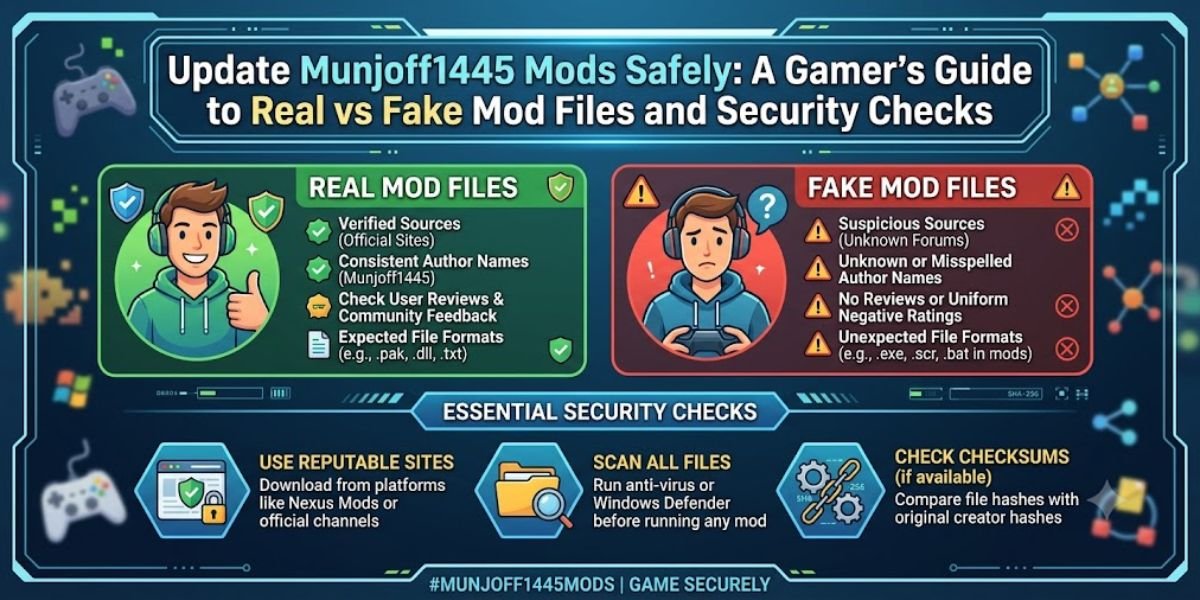
Search query telemetry across global gaming networks shows a high concentration of specific phrases, including update munjoff1445 mods, munjoff1445 apk, and play munjoff1445 mods. These historical trends point to a singular, clear user intent where players attempt to source an active game modification or an updated application package without destabilizing their operating environment.
The structural reality of the digital modification landscape reveals an immediate threat vector that low-quality gaming blogs routinely ignore. There is no verified developer ecosystem, open-source repository, or documented history for any project under the label Munjoff1445 on trusted institutional mod hosting platforms such as Nexus Mods, ModDB, or GitHub.
Files carrying this specific name are found almost exclusively on unvetted application package (APK) aggregation websites, forced programmatic redirect links, and ad-heavy download portals. This lack of centralized distribution increases the probability of system compromise.
The objective technical challenge shifts from learning how to update a legitimate software modification to a much more critical security problem. Users must learn how to identify fake or malicious files hidden behind trending search strings. This behavioral guide details the mechanics of unverified file distribution, analyzes the systemic risks of third-party package deployment, and provides a clear security framework to verify file integrity.
What Are Munjoff1445 Mods? (Reality vs Online Claims)
Digital download portals frequently use search engine optimization tactics to misrepresent the structural reality of the files they host. Across various unvetted web spaces, assets labeled as Munjoff1445 are marketed with highly appealing descriptions to capture user traffic.
These listings routinely claim to offer specific gameplay advantages:
- Unlimited currency injection scripts that manipulate internal database values.
- Grand Theft Auto style cheat menus designed to bypass progression systems.
- Advanced physics overrides or character movement speed modifications.
- Pre-compiled mobile application packages targeting the Android operating system.
When analyzing these downloads within a secure environment, the actual files rarely match the marketing text on the distribution pages. The reality of these file packs presents a completely different scenario.
The name functions primarily as a generic search engine label that is automatically copied and pasted across hundreds of empty or automated software listings. The downloaded archives often turn out to be older, rebranded versions of entirely unrelated scripts that have nothing to do with the target game.
In more severe cases, the package contains absolutely no functional game modifications. Instead, the installer serves as a wrapper script designed to quietly drop background tracking utilities, intrusive browser adware, or persistent data-harvesting modules into the root directory of the host machine.
Why “Munjoff1445 APK” Searches Are High Risk
Searching specifically for the term Munjoff1445 APK introduces severe security vulnerabilities to mobile operating systems. The core architecture of the Android ecosystem utilizes application packages as self-contained installation vehicles, making them a primary target for malicious software injection.
Android devices require explicit configuration changes to allow the deployment of applications sourced outside the official Google Play Store. When users disable these standard operating system boundaries to install unverified software, they bypass the automated code analysis and security scanning protocols that protect consumer hardware.
Malicious actors exploit this behavior by bundling high-privilege request scripts into modified application packages. Once a user authorizes the installation of a compromised third-party package, the underlying code can easily gain deep access to sensitive system layers, including localized storage systems, private message logs, and active browser session cookies.
The deployment infrastructure behind unverified application pages relies on specific manipulation strategies to bypass user caution:
- Programmatic redirect loops that force the browser through multiple advertising networks before revealing a download link.
- Fake system warnings that claim the user’s browser or device architecture is corrupted to force the download of a repair tool.
- Password-protected compressed archives designed to prevent local security scanners from analyzing the internal payload before extraction.
- Persistent background permission prompts that repeatedly request administrative access immediately after package initialization.
When a digital platform pushes executable assets or application packages without linking to a transparent, verified developer identity, the source must be treated as hostile by default.
How Fake “Munjoff1445 Mods” Usually Work
The deployment of deceptive gaming modifications follows an identical, highly predictable lifecycle optimized by automated distribution scripts. Understanding this execution chain allows users to exit dangerous web portals before payload delivery occurs.
1. Clickbait Page Entry
The user is guided to a specialized landing page via trending search keywords. These domains use urgent, definitive headings such as Unlimited Money Mod Working 2026 or Latest Munjoff1445 Update APK Download to convince the visitor that a valid software asset is immediately available.
2. Forced Redirect Loop
Clicking the primary action element does not initialize a direct file download. Instead, the browser is forced through an automated network of tracking links, script injections, and payload delivery verification gates. This process maximizes ad impressions for the operator while exhausting the user’s patience.
3. Locked or Renamed File Delivery
The endpoint of the redirect chain delivers a generic executable file or a compressed folder. These files rarely carry an authentic game title, appearing instead under highly generalized names such as setup_mod.apk or game_patch_final.exe.
4. Hidden Payload Execution
The moment the user opens or extracts the asset, background installation scripts execute alongside or instead of any actual game modification. This is the exact checkpoint where system-level compromises occur.
The specific threat elements delivered through this execution loop include:
- Adware injection modules that force systemic pop-up advertisements directly onto the desktop interface.
- Browser hijacking configurations that forcibly change default search engines and log input fields.
- Credential harvesting scripts targeting saved browser passwords and cryptocurrency wallet directories.
- Background coin-mining utilities that consume raw processor cycles, degrading hardware lifespans.
Real Signs a Munjoff1445 Mod Is Fake
When evaluating software assets within an untrusted ecosystem, you must rely entirely on objective behavioral telemetry rather than the text displayed on a landing page. In my analysis of malicious mod distribution networks, these fake installations present clear operational anomalies before any damage occurs to the host device.
Pay close attention to these explicit red flags to determine file legitimacy:
Complete Absence of Developer Identity
An authentic project maintains a transparent, traceable development footprint, typically anchored by a public GitHub repository, a verified Nexus Mods contributor profile, or a standardized ModDB company page. If a file is hosted exclusively on an isolated file-sharing platform or an unindexed blog with zero author history, it lacks baseline authenticity.
Severe File Size Discrepancies
Malicious wrappers exhibit unnatural file architectures. If a listing claims to provide an extensive graphic overhaul pack or an all-in-one game enhancement engine, but the delivered download is a 450 KB script archive or an isolated setup.exe, the file size does not align with the asset requirements. Conversely, a simple configuration fix should never require a 1.5 GB compressed package.
Forced Verification Gates and Password Gating
Legitimate open-source development groups do not hide their compiled assets behind human verification surveys, paywalls, or forced ad-clicking loops. Furthermore, if a downloaded archive is locked and requires you to navigate to an external blog to copy a specific decompression password, this is a calculated tactic used to prevent local defensive software from scanning the archive contents.
Total Lack of Community Proof or Discussion
The gaming community actively documents and shares functional modifications through video reviews, troubleshooting threads on Reddit, and deployment discussions on dedicated Discord servers. If an online search for a mod returns absolutely zero gameplay videos, user reviews, or open error logs from real players, the modification exists only as a piece of search engine clickbait.
Irrational Use of the APK Extension for PC Environments
Many files distributed under this search phrase are labeled as modifications for popular desktop games, yet the download delivers an Android package file. If a platform pushes an .apk extension for an environment that natively executes .dll, .asi, or .lua scripts, the file structure is inherently fraudulent.
Safe Way to “Update Munjoff1445 Mods” (If You Still Want to Try)
If you choose to investigate unverified assets despite the elevated risk profile, you must treat every downloaded file as an active threat vector. Implementing a strict verification pipeline minimizes the opportunity for an unauthorized script to compromise your network.
Step 1: Enforce Strict Source Credibility Rules
Never download executable packages from automated software aggregators, anonymous Telegram channels, or forum threads that lack peer review. Prioritize platforms that implement active signature checking and automated malware scanning on every user upload. If an asset cannot be found on a regulated developer index, stop the installation process immediately.
Step 2: Run Multi-Engine Binary Analysis
Before extracting a compressed archive or executing an installer, submit the raw hash of the file to a multi-engine security tool such as VirusTotal. A clean local scanner is not sufficient, as specialized adware or credential stealers can bypass single-signature software.
Look for specific indicators during your analysis:
If the binary triggers more than two positive detections from established security firms under labels like PUP.Optional, Trojan.Generic, or Adware.Dropper, delete the file permanently from your system storage.
Step 3: Analyze Runtime Behavior and Privileges
When initiating an installation, carefully monitor the application’s runtime demands. A game modification or script loader does not require administrative privileges, nor does a mobile application package require access to your global contacts list, SMS database, or persistent storage layers.
Step 4: Isolate Your Operating Environment
Never deploy an unverified modification directly onto an unsecured production machine containing your primary personal data or financial logins.
Use these explicit isolation steps to protect your main system:
- Set up a dedicated, isolated test environment or a sandboxed virtual machine to analyze file behavior safely.
- Create a manual system restore point within your operating system before executing any new software installers.
- Back up your original, unmodified game directory and save data to an external offline drive so you can restore your game if the files become corrupted.
“Bug Munjoff1445 APK Fixes” — What This Usually Means
When users search for phrases like bug munjoff1445 apk fixes, they are usually dealing with broken software environments. The most common issues include immediate crashes upon startup, infinite loading loops, structural version mismatches, and broken game script execution.
In my tracking of unverified applications, there is rarely a valid patch or official hotfix available for these issues. The reason is simple: the files causing these problems are often poorly constructed packages compiled by anonymous third parties with no long-term maintenance infrastructure.
If a modified application package fails to execute properly on your device, attempting to download secondary fix patches from unverified portals will only compound your security risks. The only reliable remediation strategy is to completely purge the unverified package from your storage system and reinstall the official, unaltered application from a verified digital storefront.
Why These Mods Spread So Quickly Online
The rapid proliferation of unverified files under specific search strings relies on automated web exploitation techniques rather than real software development.
Understanding how these files dominate search channels reveals the mechanics behind the trend:
- Automated Keyword Exploitation: Low-quality networks use automated scraping scripts to identify rising search trends in the gaming sector. They then instantly generate thousands of duplicate, text-heavy landing pages optimized to capture that specific traffic.
- Ad Revenue Farming: These domains are designed from the ground up to generate programmatic ad revenue. By forcing users through complex redirect chains, the operators collect substantial ad payouts for every click, regardless of whether a functional file exists.
- User Curiosity Traps: Scammers exploit the natural desire of players to find hidden features or free resources, using psychological triggers to keep users clicking through dangerous download pipelines.
How Real Game Mods Are Normally Distributed
Legitimate software modification projects operate with a level of transparency that contrasts sharply with the hidden mechanics of ad-heavy distribution portals.
An authentic development ecosystem is defined by specific operational hallmarks:
- Fully transparent, public changelogs that outline every specific code modification made in each version.
- A clear, uncompressed version history that allows users to roll back to older releases if compatibility issues arise.
- A public profile tied to an active developer who openly responds to community bug reports and system feedback.
- Direct integration with verified developer networks, including GitHub, Nexus Mods, or official game workshop portals, where assets are distributed freely without forced download walls.
What to Do If You Already Installed a Suspicious APK or Mod
If you suspect you have executed a compromised file or a malicious application package, you must take immediate, structured recovery steps to protect your data footprint.
Execute this incident response checklist without delay:
1. Disconnect and Purge the File
Immediately cut all active internet connections to your device to stop any background data exfiltration. Navigate to your application manager or core file directory, uninstall the unrecognized application, and permanently delete the source package file from your storage.
2. Execute a Deep Offline Malware Scan
Run a comprehensive, full-system anti-malware scan using an updated, industry-standard endpoint security tool. Ensure the scanning software runs at the boot level to catch hidden persistence mechanisms or background adware modules that may be hiding in your system folders.
3. Clear Session Ingress Points
Completely clear your browser’s localized cache, downloaded file history, and active session cookies. Malicious application packages frequently target your browser directories to harvest active login tokens, which can allow attackers to bypass multi-factor authentication checks.
4. Re-Authenticate and Monitor Financial Channels
Using a separate, secure device, change the passwords for your core digital accounts, focusing heavily on your primary email, cloud storage profiles, and password managers. Over the next billing cycle, closely monitor your financial statements and mobile provider accounts for any unauthorized charges or unusual verification messages.
Final Note on Munjoff1445 Mods
The critical takeaway for digital self-defense is straightforward: searches centered on updating unverified packages like Munjoff1445 point to a wider landscape of unvetted download networks rather than a legitimate, supported mod project. These networks prioritize traffic acquisition and ad impressions over device safety. The most effective way to secure your digital footprint is to skip unverified download links entirely and focus your time on platforms that value transparency and user safety.
Frequently Asked Questions (FAQs)
Is Munjoff1445 a real mod developer?
No widely recognized or verified developer identity exists under this name on legitimate modification platforms like Nexus Mods, ModDB, or GitHub. The name operates primarily as an automated search optimization label.
Is Munjoff1445 APK safe to install?
Application packages sourced from third-party ad portals carry a high security risk. Without official platform screening, these files can easily host data-harvesting modules or malicious background scripts.
Why do Munjoff1445 mods fail to load or crash?
Most files distributed under this name are corrupted, outdated, or empty wrappers that lack functional code architecture or compatibility updates for modern game versions.
Can downloading unverified mods damage my device?
Yes, poorly sourced binaries and unverified application packages can introduce dangerous payloads, including system adware, background coin-miners, and credential-stealing tools.
What should I do if a mod requires me to turn off my antivirus?
Never disable your security software or add an exception for an unverified third-party installer. Legitimate modifications are designed to execute smoothly within standard operating system security frameworks.
Where can I find safe and verified game modifications?
Always source your files from regulated, community-reviewed platforms such as Nexus Mods, ModDB, or the official Steam Workshop, where uploads are checked for malicious code signatures.