
Most commercial operations stall not from a shortage of tactical ideas but from systemic fragmentation. When growth bottlenecks occur, organizations routinely treat the symptoms rather than the root cause. They launch aggressive advertising campaigns to compensate for a mispriced offer. They ship advanced product features while ignoring a friction-heavy customer onboarding journey. They expand into new distribution networks without establishing the logistical infrastructure required to fulfill the resulting demand.
These disconnects happen when corporate functions operate within isolated silos. The marketing mix functions as an integrative business architecture designed to eliminate these exact structural gaps. Far from an academic classification system meant for textbook study, it serves as an operational blueprint that forces direct alignment across product development, finance, distribution channels, and public positioning.
When a leadership team coordinates every lever of the marketing mix into a unified framework, it builds structural predictability into customer acquisition and retention. If these elements are left unaligned, a business ends up burning capital on fragmented campaigns that fail to convert long-term market share.
What Is Marketing Mix?
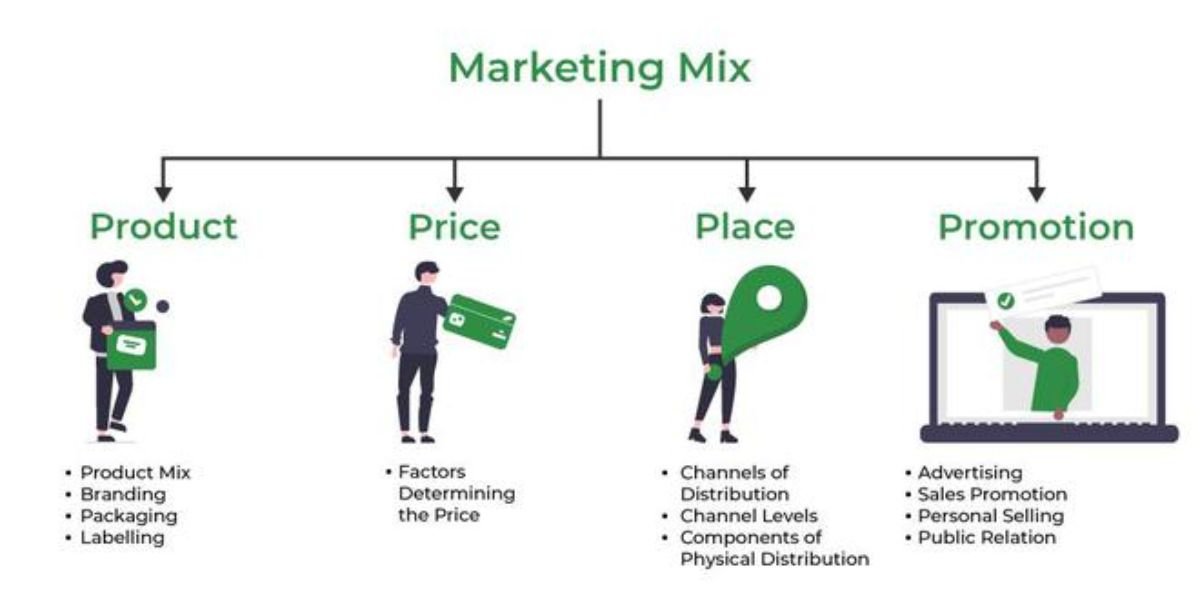
The marketing mix is an operational management framework used to design, audit, and execute a company’s total market offering by structuring how a firm builds value, validates it through pricing, distributes it across physical or digital environments, and scales its visibility through promotional channels.
The origin of the term traces back to the late 1940s when Harvard Business School professor Neil H. Borden began using the concept in his lectures, inspired by colleague James Culliton’s description of a business executive as a mixer of ingredients. Borden formalized this framework in his landmark 1964 paper, The Concept of the Marketing Mix.
As businesses sought to make this extensive list of variables highly actionable, E. Jerome McCarthy grouped these core ingredients into the classic 4Ps taxonomy in his 1960 textbook, Basic Marketing: A Managerial Approach. McCarthy’s streamlined pillars of Product, Price, Place, and Promotion allowed executives to easily run diagnostics on asset-heavy, manufacturing-driven business models.
As the global economy shifted toward service-oriented platforms, software-as-a-service providers, and continuous digital touchpoints, the standard manufacturing baseline proved insufficient. To address these complex, intangible transaction layers, Bernard H. Booms and Mary J. Bitner published an expanded framework in 1981. This updated model introduced three service-centric operational vectors, creating the modern 7Ps framework by integrating People, Process, and Physical Evidence into the core strategy.
What Is the Purpose of a Marketing Mix Framework?
The primary purpose of the marketing mix framework is cross-functional alignment, serving as a functional bridge that ensures product managers, finance directors, logistics coordinators, and growth teams operate under a single, shared commercial thesis rather than in isolated operational silos.
Without this structural integration, enterprises inevitably suffer from systemic disconnects. Engineering teams build unmarketable features, finance sets margin targets divorced from competitive realities, growth teams burn capital acquiring low-value accounts, and support operations collapse under unexpected pipeline strains.
Using the mix as an active diagnostic tool forces an enterprise to continuously verify that its product utility directly corresponds with its pricing logic, channel accessibility, and public messaging.
The 4Ps for Product
Product
A product is the functional outcome, utility, and operational relief a customer experiences during usage, rather than a mere collection of technical specifications or physical inputs. In enterprise software, the true product is the elimination of communication silos and the acceleration of delivery speeds. In e-commerce, it is the absolute predictability of logistics and supply chain reliability. In payment processing, it is systemic transaction security and the mitigation of cross-border financial risk.
An exceptional product architecture is defined entirely by the friction it removes from the user’s life, requiring continuous optimization to ensure the core value proposition matches changing consumer expectations.
Price
Price is a direct mechanism for market positioning and economic survival that assigns a financial value to an offer, serving as a psychological signal that shapes consumer perception before a transaction occurs.
Organizations navigate this vector using distinct strategies. Premium pricing is used to intentionally signal elite quality. Value-based pricing ties costs directly to the measurable economic savings realized by the buyer. Tiered subscription pricing segments users based on growth stages. Freemium models lower entry barriers while gating advanced administrative tools.
Ultimately, price dictates an enterprise’s margins, determines which customer segments are economically viable to acquire, and establishes the capital available for reinvestment.
Place
Place encompasses the exact physical locations, digital environments, and distribution networks where a target audience discovers, evaluates, and buys a product, controlling the overall convenience and transaction friction experienced by the customer.
The modern distribution landscape requires maintaining a highly available omni-channel presence across algorithmic search environments, centralized application marketplaces, programmatic commerce ecosystems, or direct-to-consumer digital infrastructure.
If a product is not natively positioned exactly where a target customer naturally spends their time and attention, it becomes functionally invisible, making the minimization of intermediate channel friction a commercial necessity.
Promotion
Promotion is the structured coordination of messaging, media channels, and public communication strategies designed to build measurable market awareness, establish authority, and drive conversion over time.
Rather than relying on disjointed, high-cost ad campaigns, successful organizations deploy an integrated mix of inbound content frameworks to solve complex industry challenges, targeted paid acquisition to capture high-intent buyers, organic search optimization for commercial queries, and earned media partnerships to leverage third-party validation.
The baseline goal of promotion is simple, create systematic, repeated exposure that transforms passive market awareness into deep institutional trust.
The 7Ps for Service and Digital Businesses
People
The people vector represents the human capital, employee behaviors, and organizational culture that shape how a customer experiences a brand during live interactions, functioning as the actual product in high-touch B2B environments.
The operational quality of this element directly impacts customer retention and long-term customer lifetime value, heavily relying on the execution of customer-facing technical support technicians during operational outages, strategic account managers during complex implementation phases, and frontline service delivery agents.
Because a single negative interaction can instantly erase years of expensive brand equity, maintaining a high-performing people vector requires rigorous training and clear data-driven performance metrics.
Process
Process refers to the precise sequential workflows, operational protocols, and systemic mechanisms through which a company delivers its value proposition, defining the consistency, speed, and reliability of the user journey.
When process execution is poorly designed, customer churn spikes regardless of campaign effectiveness, highlighting the need for optimization across global logistics operations, user onboarding journeys, and corporate invoicing workflows.
Optimizing this vector requires mapping every customer touchpoint to pinpoint bottlenecks, eliminate unnecessary manual steps, and automate repetitive tasks, transforming an abstract brand promise into a predictable reality.
Physical Evidence
Physical evidence consists of the tangible touchpoints, visual environments, and digital trust signals that verify a business’s operational legitimacy and capability, serving as the ultimate tool for risk mitigation in digital-first commerce where buyers cannot physically handle an item before purchase.
Organizations systematically build out this portfolio by displaying independent third-party compliance audits like SOC 2 Type II certifications, showcasing authenticated customer reviews on high-intent conversion pages, publishing deep data-backed case studies, and maintaining clean user interface craftsmanship across web properties.
Providing clear physical evidence systematically removes the psychological friction of buyer hesitation by confirming an organization’s contractual capabilities.
The Difference Between 4Ps and 7Ps
The core structural difference between the 4Ps and the 7Ps lies in their operational focus across the customer lifecycle, where the 4Ps govern market entry, product positioning, and customer acquisition, while the 7Ps extend that model to control long-term service delivery, operational execution, and customer retention.
The 4Ps give organizations a clear framework to define what is being sold, what it costs, where it is hosted, and how it is promoted. Conversely, the 7Ps introduce people, process, and physical evidence to shift focus from the transactional point of sale to the long-term relationship lifecycle.
While manufacturing firms can often rely primarily on the 4Ps to move physical inventory through traditional retail pipelines, modern digital enterprises must master both, as initial acquisition is financially worthless if poor customer onboarding processes or undertrained support teams cause users to churn within thirty days.
How Businesses Implement the Marketing Mix in Real Campaigns
In live corporate environments, an executive team never treats the components of the marketing mix as isolated items on a checklist, running them instead as a single, highly integrated growth system where a change to any single variable triggers an immediate adjustment across all others.
When executing an integrated acquisition or expansion campaign, the cross-functional coordination follows a precise sequence where the product team isolates a specific high-value challenge, the finance team establishes an optimal pricing model, the distribution team configures landing pages, and the promotion team writes targeted messaging assets.
Simultaneously, operations teams design seamless registration workflows while support staff undergo rigorous training on the campaign’s nuances to resolve incoming customer tickets rapidly.
If any single link in this chain fractures, the entire campaign underperforms, because a high ad budget cannot fix a broken signup page, just as an exceptional user interface cannot save a business forced into channels where its audience is completely absent.
Example Case Studies of Marketing Mix in Real Companies
Slack
Slack’s rapid expansion across enterprise environments offers an excellent example of structural alignment within the marketing mix, turning product utility into an organic growth loop.
The product was engineered as a high-speed corporate communication ecosystem that consolidates file sharing, direct messaging, and third-party app integrations into an intuitive interface. To drive adoption, they deployed a disruptive pricing structure via a freemium model that offers full basic functionality for small teams, while gating historical archive search limits and enterprise security keys behind premium tiers.
Its place strategy relied on distribution through native cross-platform applications and centralized app marketplaces to remove installation friction, while its promotion bypassed traditional high-cost advertising to focus heavily on organic peer-to-peer viral loops within teams and word-of-mouth recommendations.
Finally, Slack optimized its onboarding process to allow a non-technical user to spin up a functional company workspace in under sixty seconds, supported by a specialized people layer of dedicated developer relations and customer success teams to facilitate complex external integrations.
Amazon
Amazon maintains market dominance by exercising absolute operational control over every vector of its global mix, prioritizing delivery speed and infrastructure reliability.
Its core product is an uncommonly vast digital marketplace combined with secondary cloud computing ecosystems, digital media assets, and subscription membership benefits. For its monetization, Amazon utilizes algorithmic data models to adjust prices dynamically in real time based on competitive inventory volumes and immediate market demand.
The digital storefront serves as its central place, supported by a massive global network of fulfillment centers and sortation hubs, while its promotion engine leverages high-volume search engine dominance, dynamic personalized onsite recommendations, and retargeting systems.
The enterprise’s core competitive advantage lies in its process vector, an industry-defining logistics infrastructure that automates picking, packing, sorting, and last-mile delivery tracking. This operational mastery is validated by continuous physical evidence, including millions of verified customer product reviews, seller rating histories, clear delivery countdown timers, and instantly visible packaging branding.
PayPal
PayPal secured its early market share by focusing heavily on trust building and embedding its distribution directly into early e-commerce environments.
The original product was a highly secure, abstract digital transaction layer that allowed consumers to complete payments without exposing sensitive bank credentials directly to unknown merchants. The financial framework utilized a split pricing strategy that kept transactions free for retail consumers while charging a percentage-based transaction fee directly to merchants in exchange for immediate access to high-intent buyers.
PayPal optimized its place strategy by embedding natively as a payment gateway button directly inside thousands of independent retail websites and digital auction checkout lines. To scale user growth, its promotion architecture deployed a highly successful double-sided financial referral bonus that rewarded both existing and new users upon account activation.
This entire network loop depended on immediate physical evidence, establishing the omnipresent secure checkout badge across the web, combined with explicit Buyer Protection policies that guaranteed refunds for unfulfilled orders to eliminate transaction anxiety.
Netflix
Netflix converted its business from a DVD delivery system into a global streaming powerhouse by optimizing its entire operational mix around personalized convenience.
The core streaming product consists of a massive library of on-demand entertainment, including high-budget original programming tailored to international market dynamics. Netflix structures its price around straightforward tiered subscription access without contract commitments, allowing users to select screen counts and stream quality levels based on household needs.
Its place distribution strategy is designed to be accessible natively across almost all modern connected hardware, including smart televisions, mobile operating systems, gaming consoles, and web browsers. To maintain engagement, its promotion heavily relies on proprietary machine learning recommendation algorithms that analyze past viewing behaviors to display hyper-personalized artwork on the user’s home screen.
This digital delivery is powered by an advanced streaming process, utilizing continuous, adaptive encoding technology that analyzes real-time internet bandwidth to prevent video buffering and deliver smooth playback.
How the Marketing Mix Can Support Your Business
The marketing mix serves as a highly practical strategic diagnostic tool, giving leadership teams a repeatable framework to stress-test their business models, optimize unit economics, and locate operational inefficiencies before they trigger financial losses.
Implementing this framework systematically upgrades an enterprise’s long-term competitive health by eliminating internal resource waste on mismatched campaigns, accelerating market entry speeds for new product rollouts, exposing overlooked operational blind spots in support pipelines, and protecting core unit economics through data-backed pricing.
By transforming marketing from a collection of scattered tactical actions into a highly connected, data-backed growth system, the marketing mix ensures that every department works together toward a singular goal, creating, communicating, and delivering undeniable value to the market.
Marketing Mix FAQs
Why is the marketing mix important for businesses?
The marketing mix is vital because it stops different parts of a business from making conflicting decisions, forcing product development, finance, distribution channels, and messaging strategies to pull in the exact same direction, turning your commercial strategy into a single, cohesive engine.
Is the marketing mix still relevant today?
Yes, the marketing mix is more critical today than ever before because modern digital business models depend heavily on complex, automated customer touchpoints across multiple channels, making it incredibly easy for data tracking, user journeys, and brand positioning to fall out of alignment without a connected framework.
What is the difference between 4Ps and 7Ps?
The 4Ps focus primarily on initial product positioning, market entry, and customer acquisition, whereas the 7Ps include those original four elements but add People, Process, and Physical Evidence to properly govern service delivery, customer retention, and lifetime value expansion.
Can small businesses use the marketing mix?
Absolutely, small businesses often get the highest immediate return from this framework because their budgets are limited, meaning they cannot afford to waste capital running ads for an offer that is mispriced or hidden in channels where their audience isn’t active.
Is the marketing mix only a marketing concept?
No, the marketing mix is a full corporate governance framework that requires direct cooperation and data sharing across finance departments for pricing, operations, and logistics divisions for place and process optimization, human resources for people training, and product engineering teams for core utility development.